Saturn

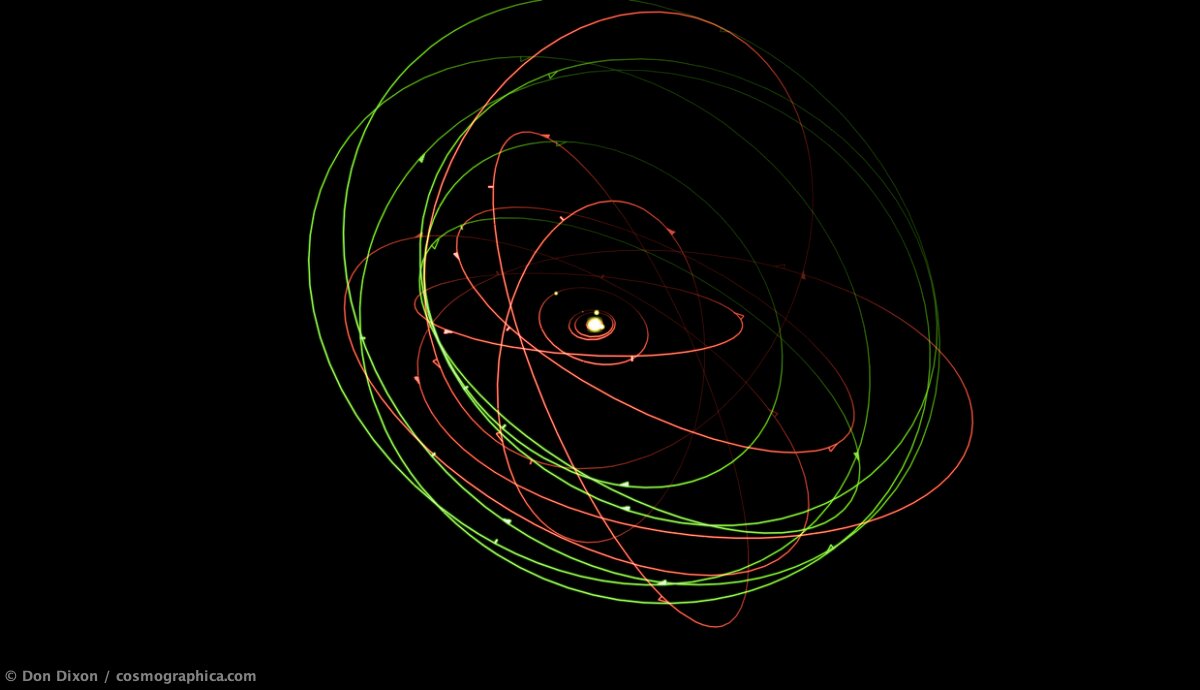
456-saturn-moon-orbit-diagram-dixon.jpg

456-saturn-moon-orbit-diagram-dixon.jpg Diagram for Scientific American shows orbits of the many satellites of Saturn. A technical data visualization illustrates the complex orbital paths of Saturn's irregular moons against a black void. The orbits are color-coded, with green and red elliptical paths representing prograde and retrograde motions respectively, highlighting the gravitational capture of small outer satellites. Arrows along the orbital lines indicate the direction of travel around the central point representing the gas giant. Artwork © 2007 Don Dixon / cosmographica.com
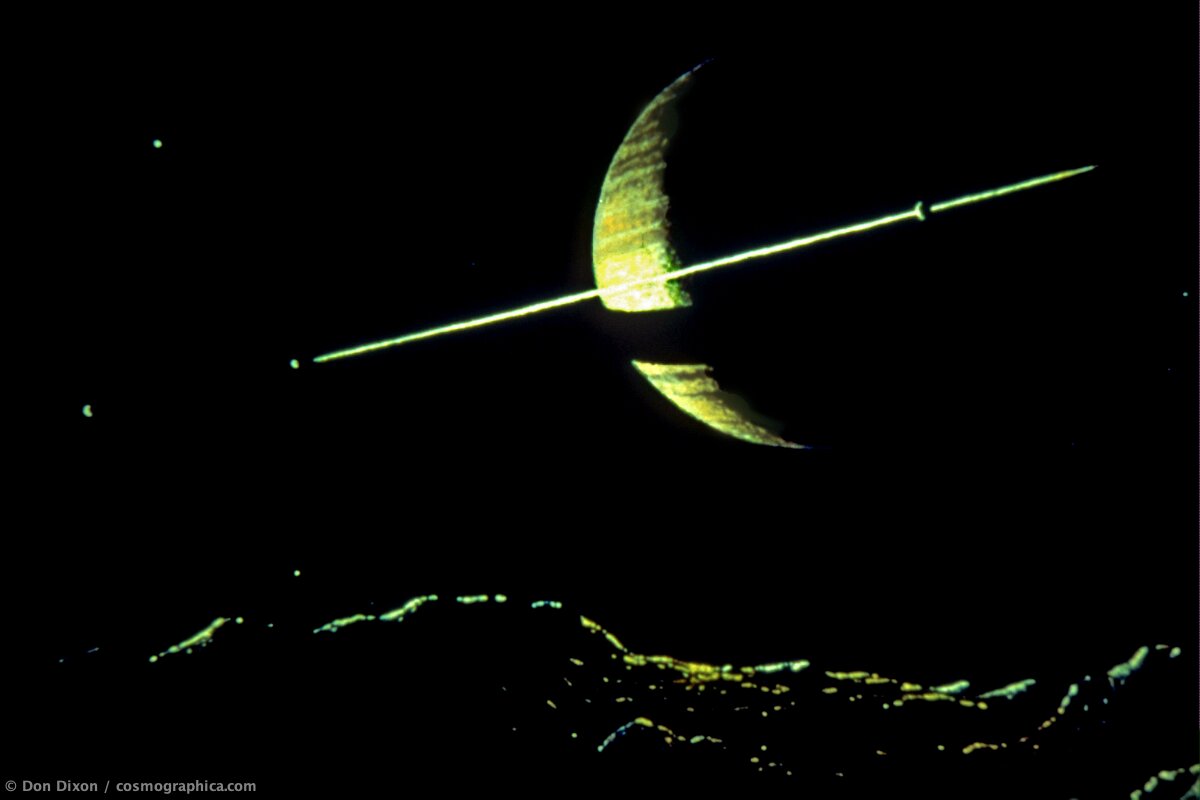
086-saturn-from-rhea-dixon
086-saturn-from-rhea-dixon – Saturn's rings appear as a thin line as seen from this icy moon ; small gouache study on board, 1983
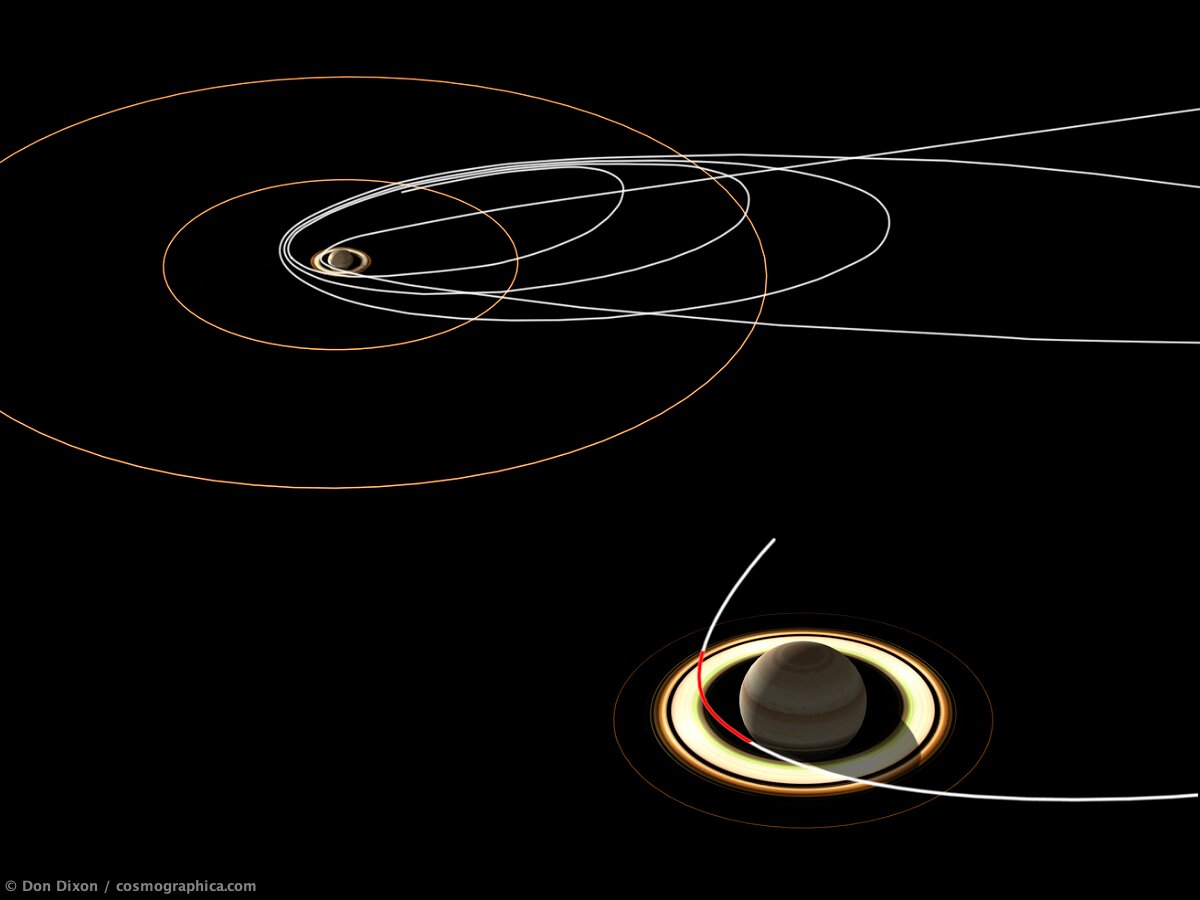
416-cassini-trajectory-dixon
416-cassini-trajectory-dixon – A two-part technical diagram illustrates the complex orbital path of the Cassini spacecraft around Saturn. The top section shows the wide, eccentric orbits used to study the planet's moons, while the bottom detail highlights the arrival burn, with a trajectory marked in red passing through the narrow gap between the planet's atmosphere and its innermost rings. This visualization demonstrates the precise navigational engineering required to explore the Saturnian system without colliding with ring debris.. Digital, 2004, for Scientific American.
392-saturn-rings-diagram-dixon.jpg

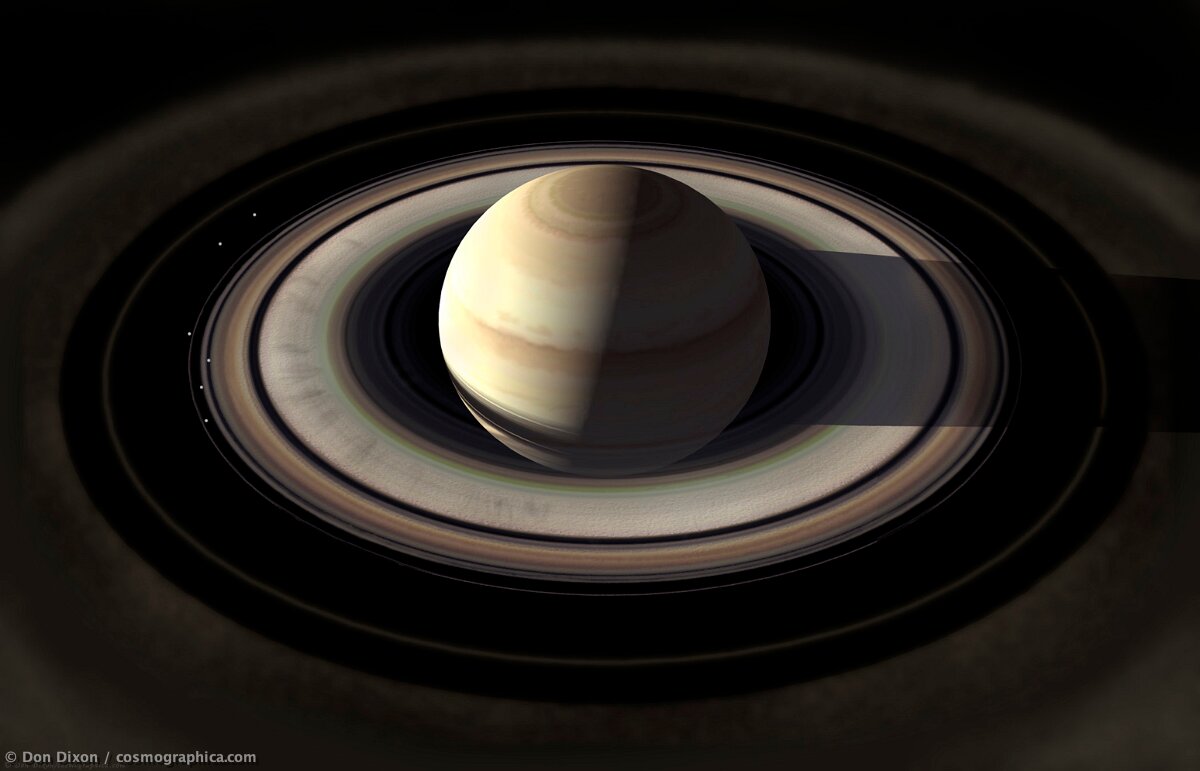
392-saturn-rings-diagram-dixon – Lord of the RIngs: Saturn's magnificent system of rings extends nearly 200,000 miles from the center of the planet, but only the denser regions are easily observerd. A technical overhead view of Saturn provides a clear visualization of the primary ring divisions and the planet's atmospheric banding. The rendering highlights the varying opacity of the A, B, and C rings, with the prominent Cassini Division appearing as a dark gap. The planet's shadow is cast precisely across the ring plane, while several small inner moons are positioned along the outer edges of the complex ring structure. Digital painting for Scientific American. © 2012 Don Dixon / cosmographica.com
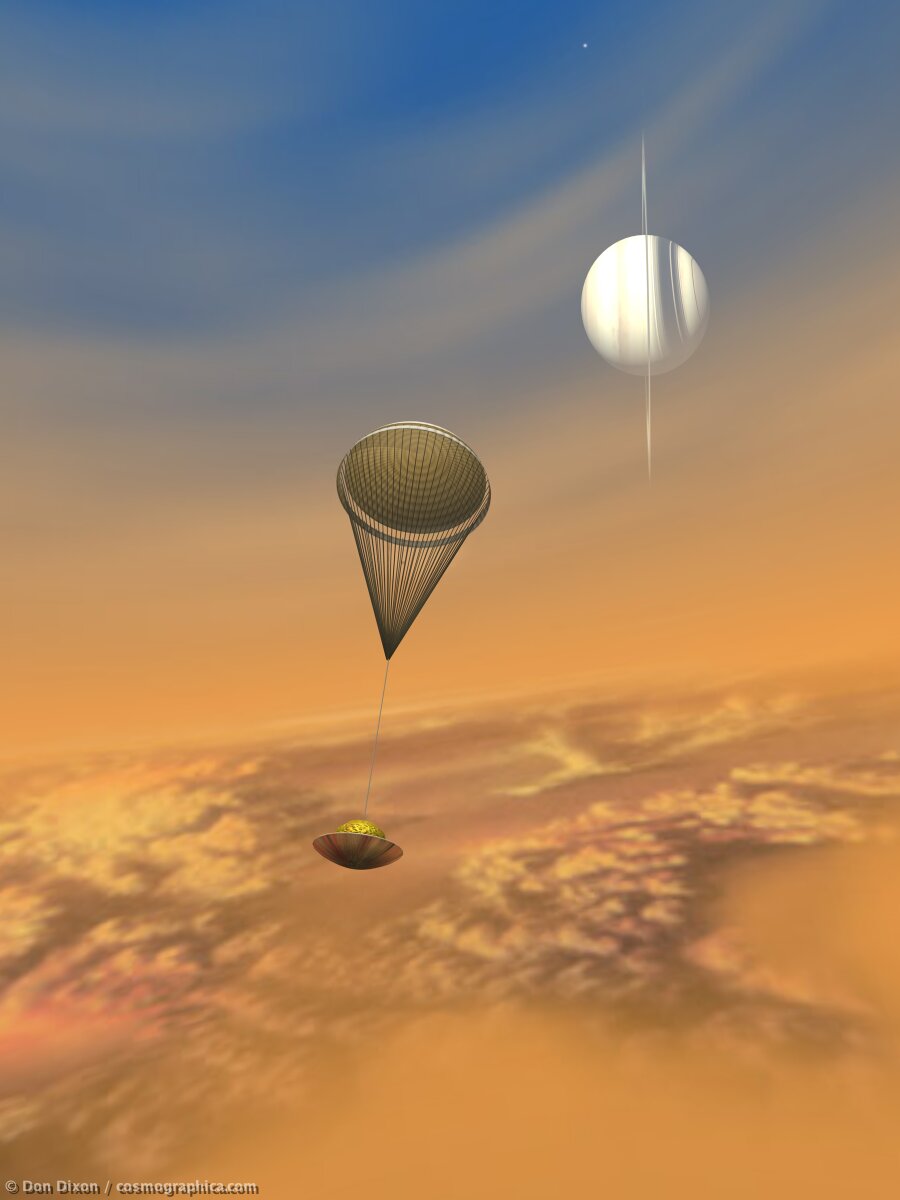
407-huygens-titan-parachute-dixon
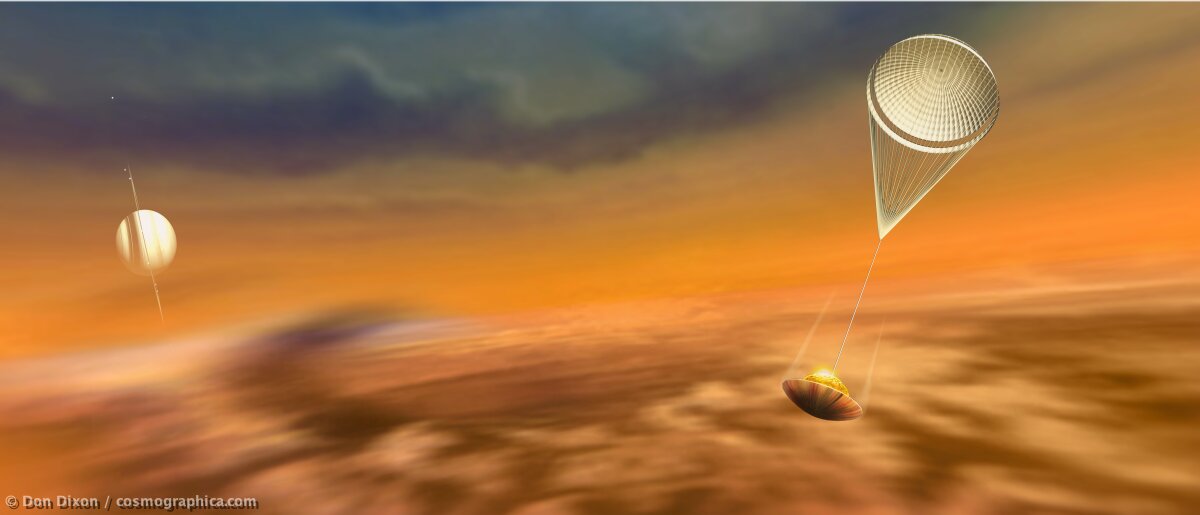
407-huygens-titan-parachute –The Huygens probe descends through the hazy, nitrogen-rich upper atmosphere of Titan, suspended from its drogue parachute. Below the probe, a thick layer of orange photochemical smog partially obscures the moon's complex surface features. In the distant sky, Saturn appears as a bright, pale orb with its rings viewed nearly edge-on Version 2. Digital, for Scientific American, 2004.
415-cassini-huygens-dixon.jpg

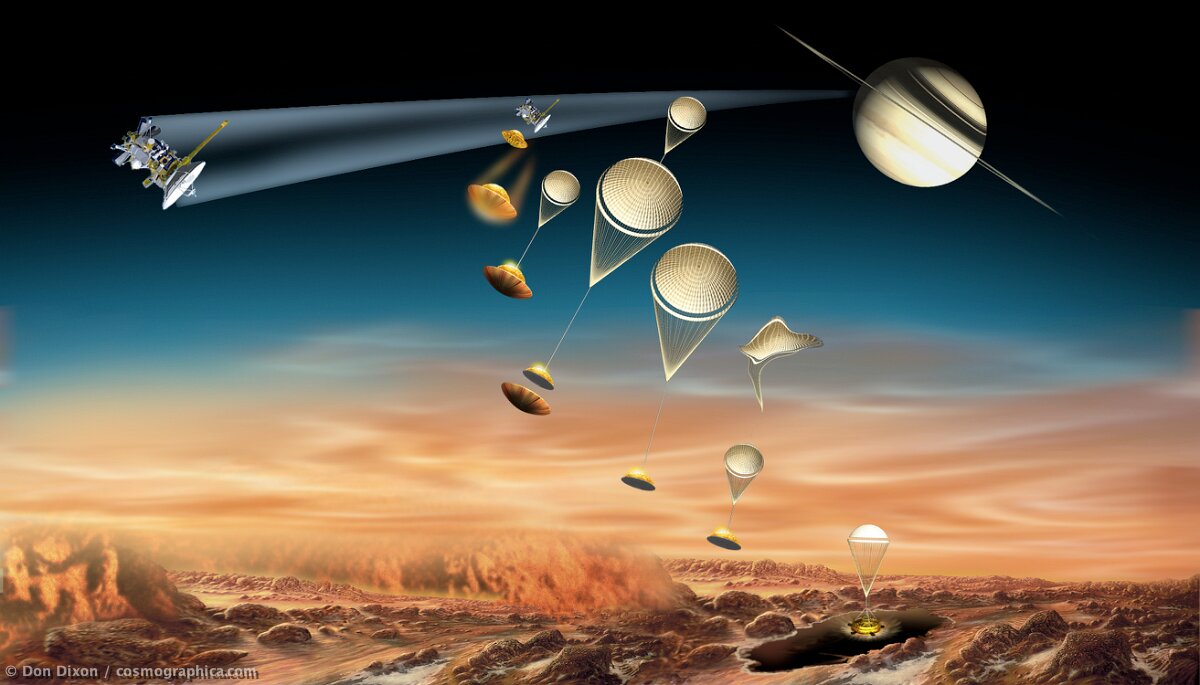
415-cassini-huygens-dixon – An infographic illustration details the sequence of the Huygens probe’s descent onto the surface of Titan, Saturn's largest moon. The diagram shows the separation from the Cassini orbiter, followed by the deployment of various parachute stages through Titan's thick, orange atmosphere, culminating in a landing on a landscape of hydrocarbon ice and liquid methane pools.Digital, 2004, for Scientific American.
107-saturn-rising-dixon
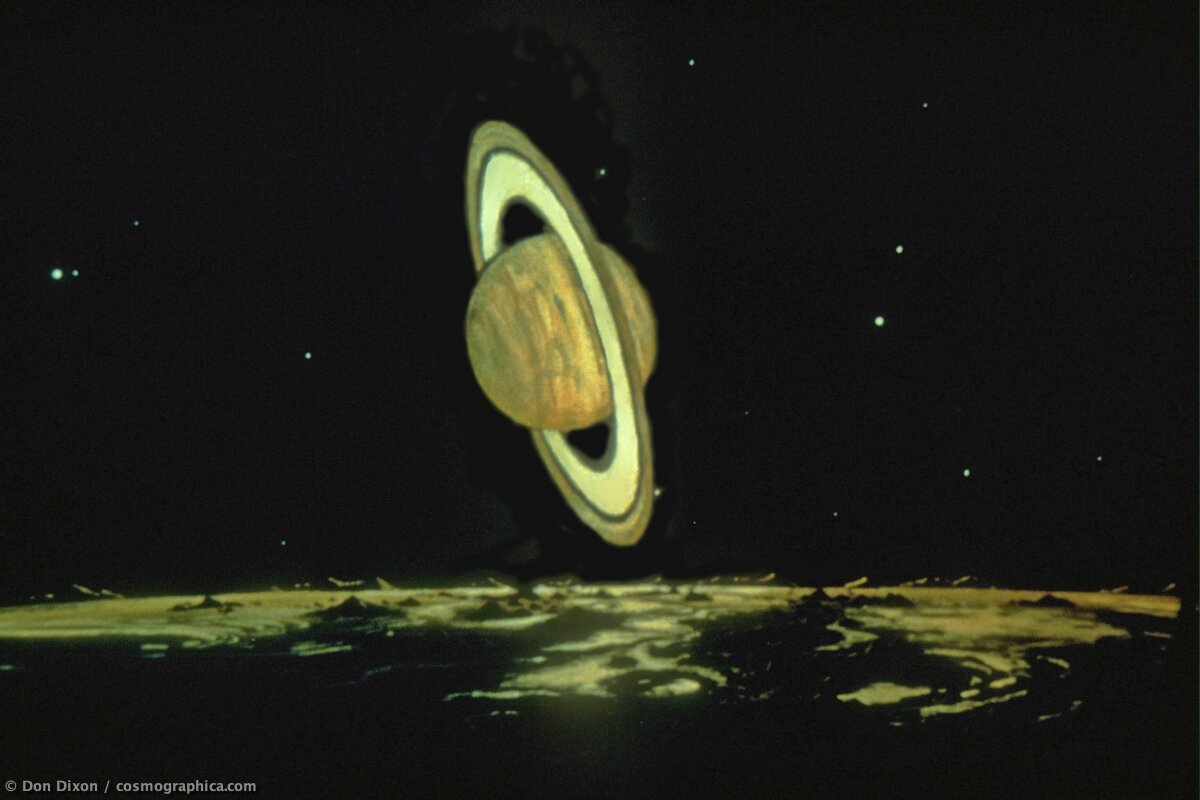
107-saturn-rising-dixon – Saturn rises above its moon Iapetus, as seen from orbit ; a small gouache on masonite study, 1975
150-encke-division-dixon.jpg

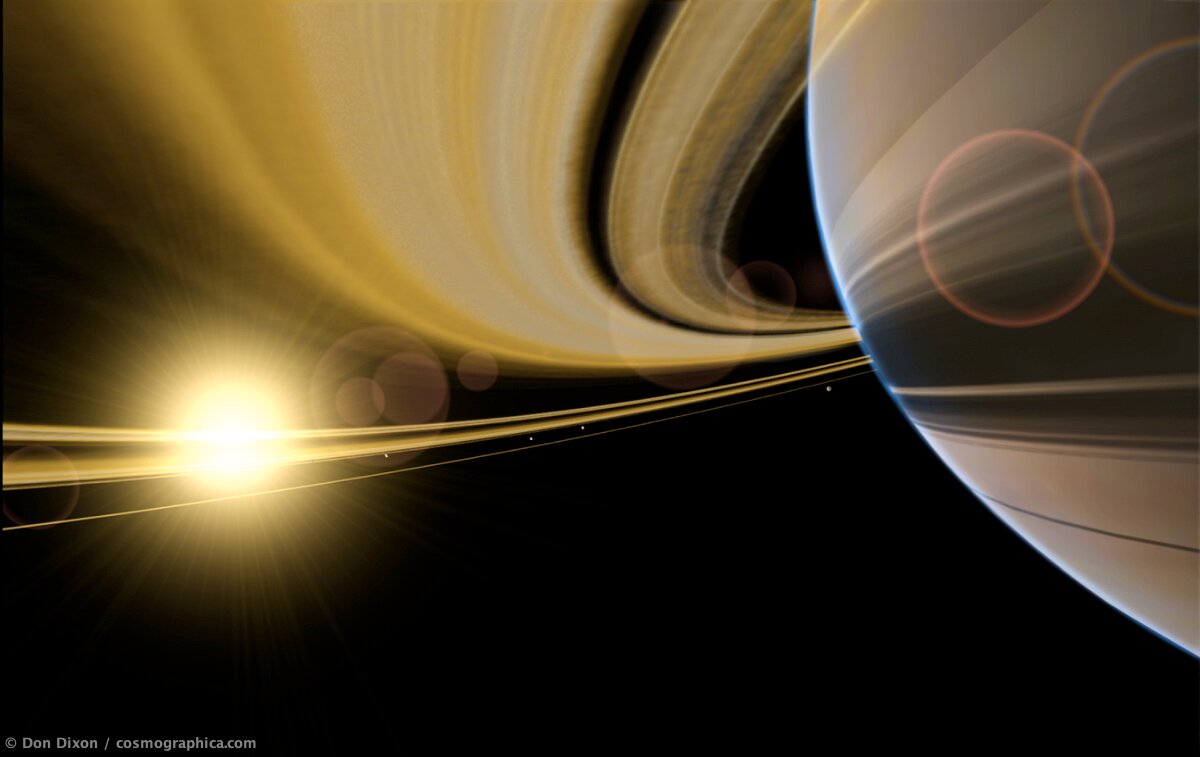
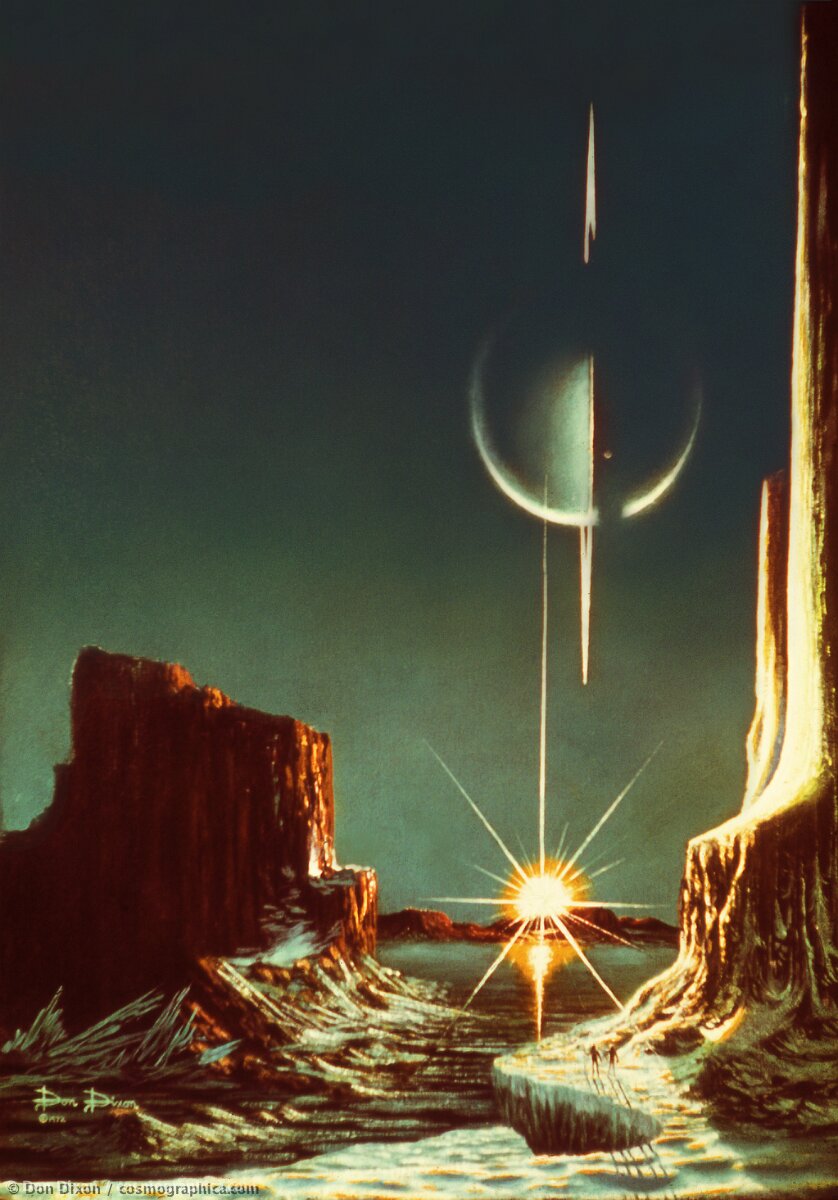
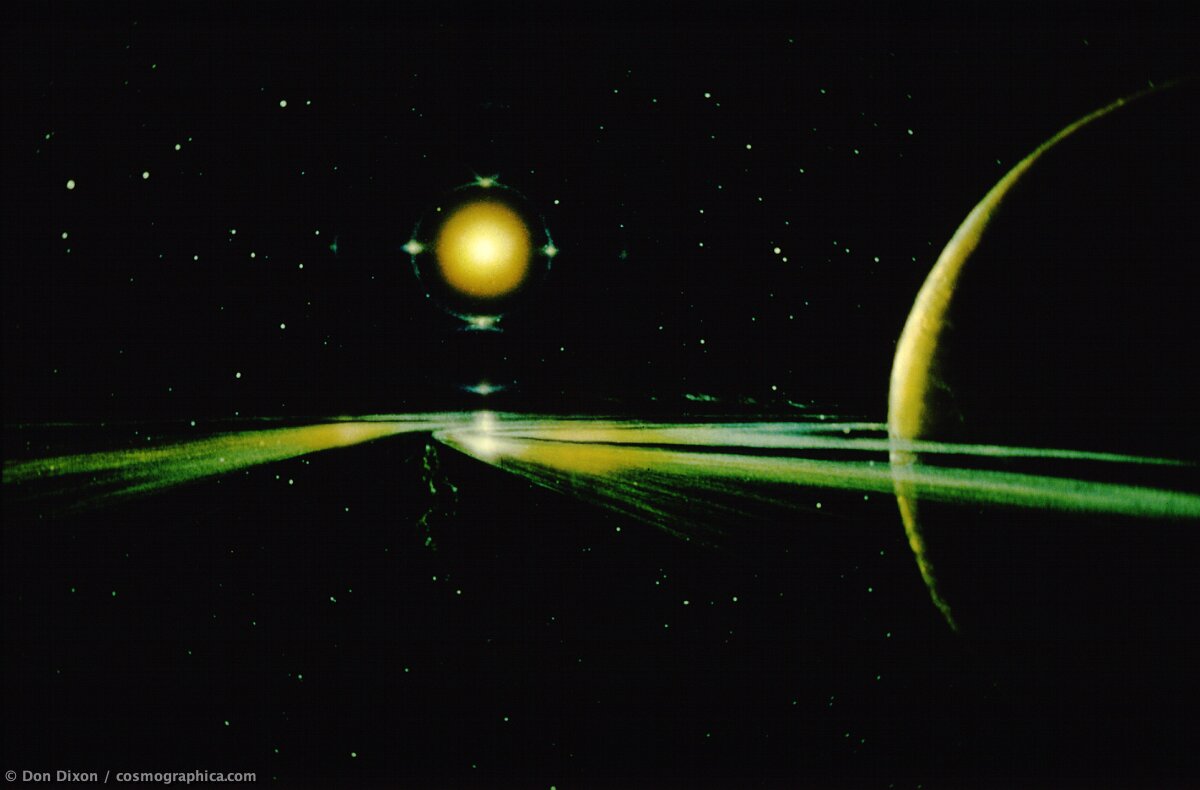
150-encke-division-dixon – A dramatic perspective from within Saturn's ring system highlights the Encke Gap, a clear lane within the A Ring kept open by the moon Pan. The sun is depicted with a prominent lens flare, casting a harsh light that reflects off the ring particles and the crescent edge of the planet. This view emphasizes the razor-thin profile of the rings and the gravitational sculpting that defines their complex boundaries.
116-titan-base-dixon
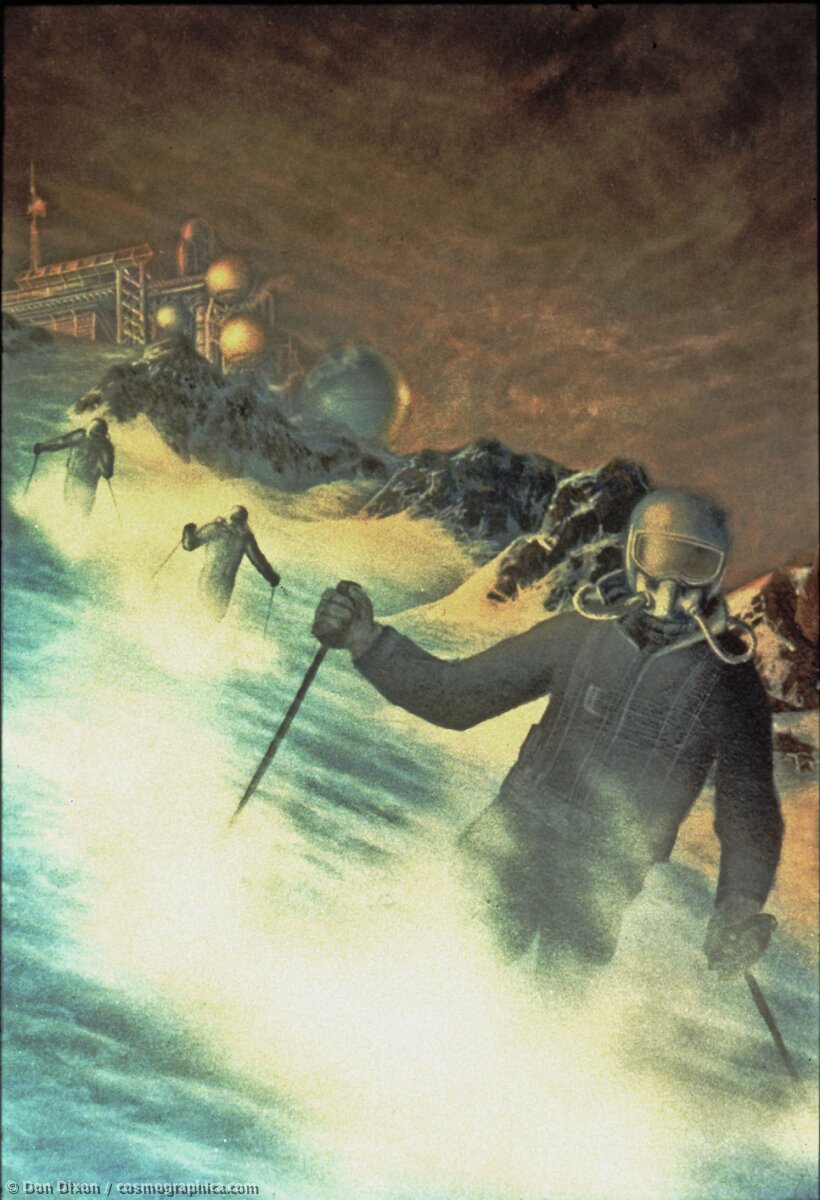
116-titan-base-dixon – A speculative science fiction scene depicting workers at a hydrocarbon mining facility on Saturn's moon as they take a ski break. Astronauts equipped with specialized environmental suits and breathing apparatuses are seen navigating a steep, slushy slope of methane ice. The low-contrast, orange-tinted sky reflects the moon's thick hydrocarbon haze and dense atmospheric conditions. acrylic on board, 1979
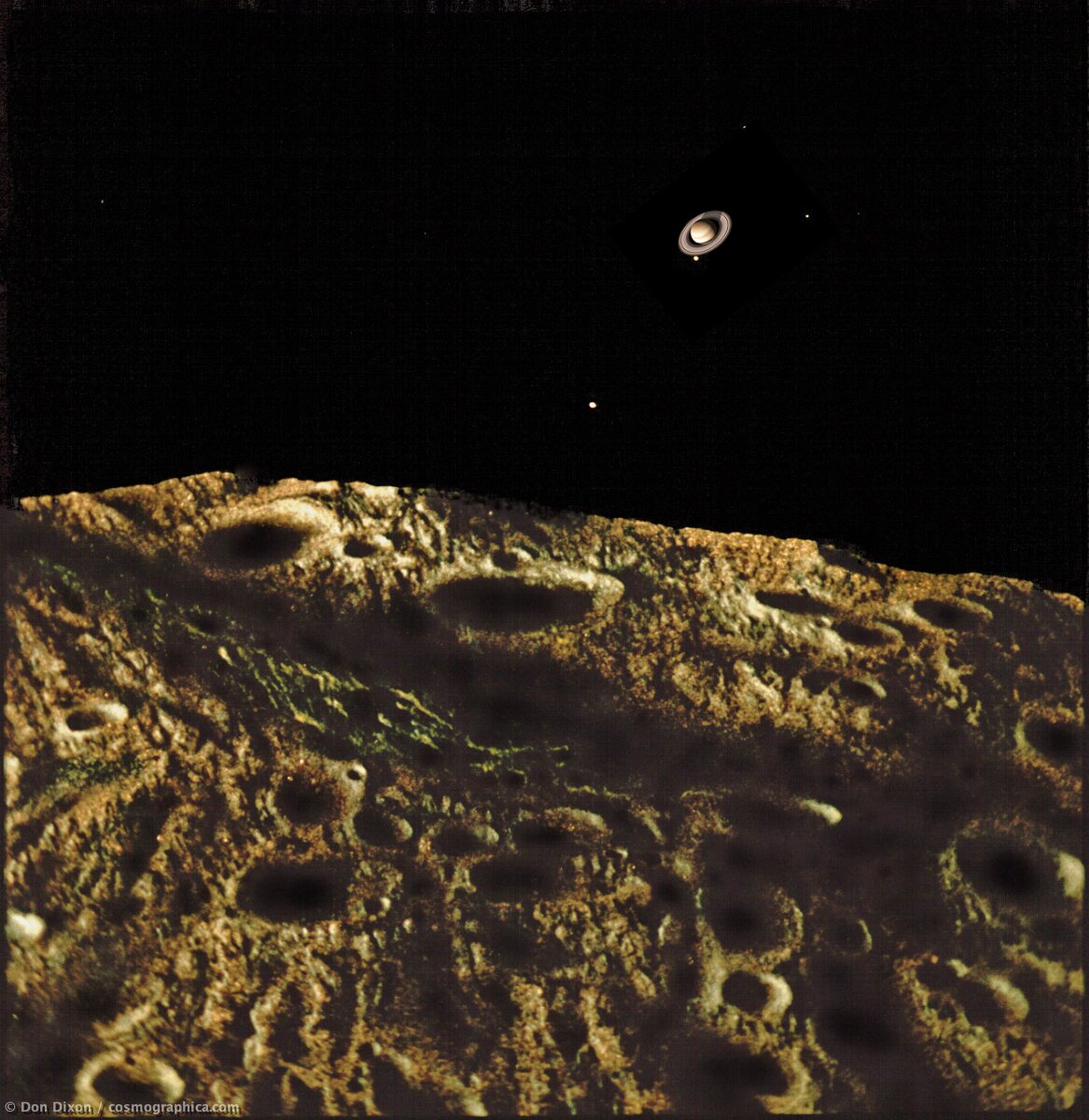
145-saturn-from-phoebe-dixon
145-saturn-from-phoebe-dixon – visualization from the heavily cratered, dark surface of the irregular moon Phoebe looking back toward a distant Saturn. The planet appears small in the black void of space, emphasizing Phoebe's remote, retrograde orbit far from the primary ring system. The foreground highlights the rugged, battered terrain characteristic of this captured Kuiper Belt object.
Exploring Saturn's Rings
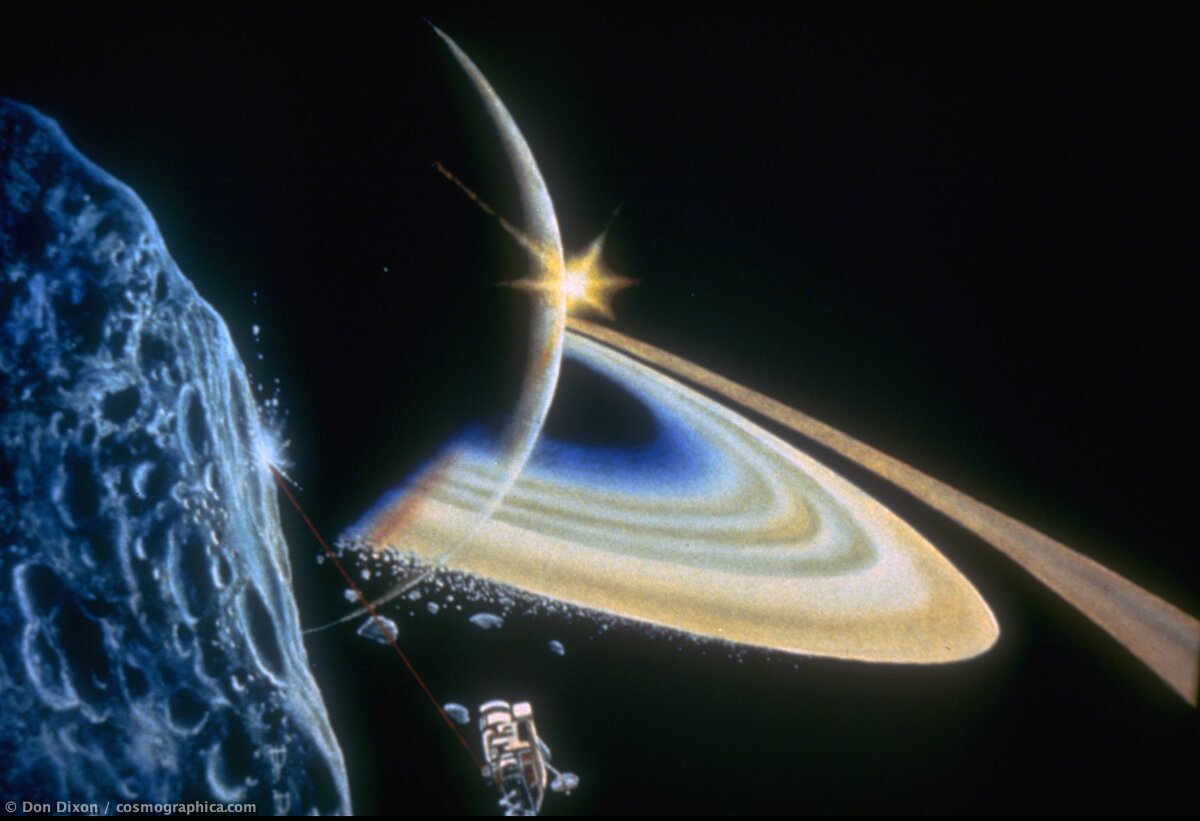
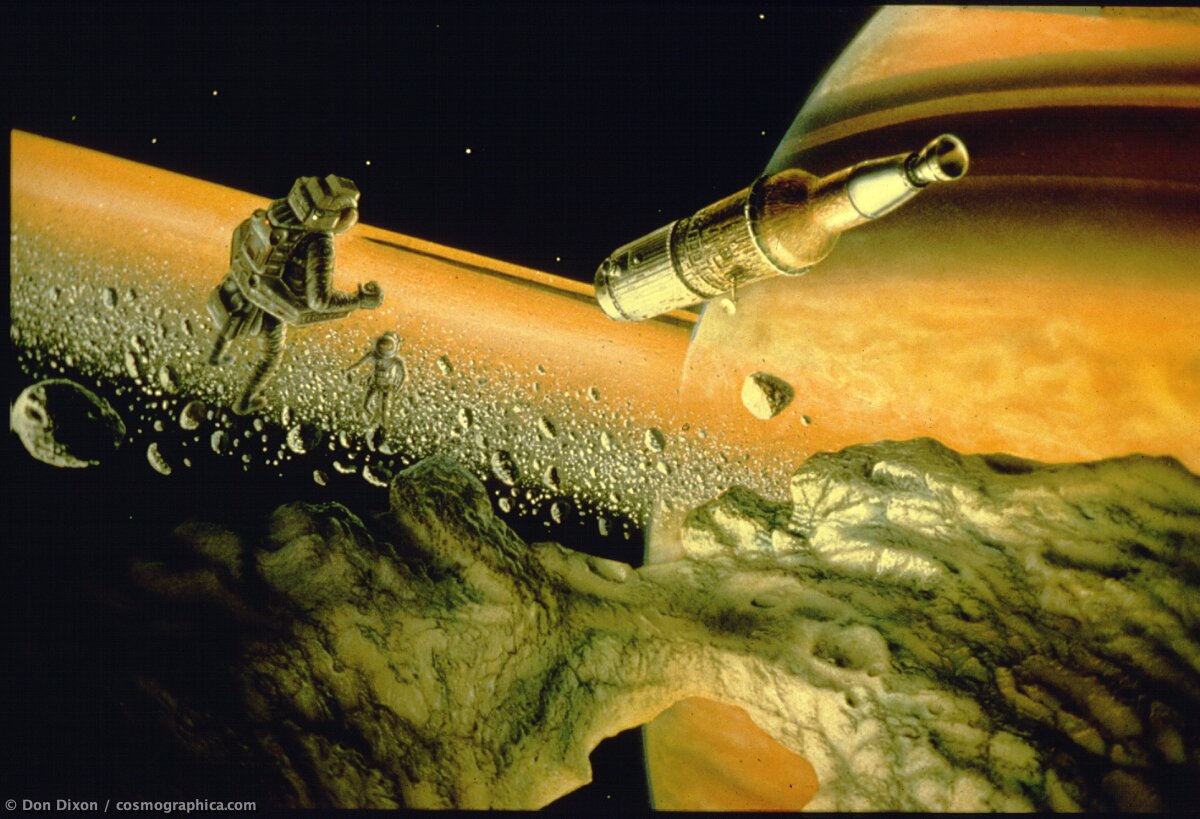
088-exploring-saturns-rings-dixon.- explorers use a laser to zap a ring fragment for spectroscopic analysis ; cover Starlog magazine, 1977; vinyl on animation cel.
149-co-orbital-moons-dixon
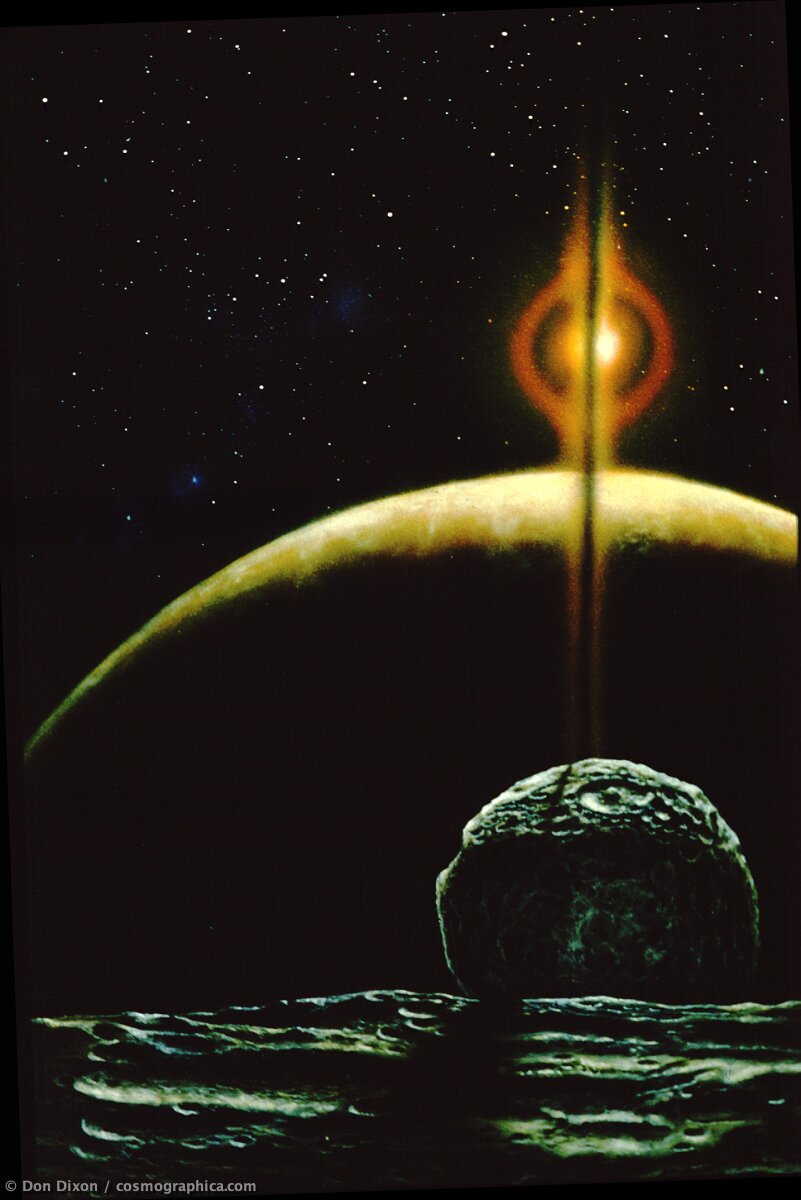
149-co-orbital-moons-dixon – A dramatic low-angle perspective from the cratered surface of a small moon, looking toward its co-orbital partner against the limb of a gas giant. A distant sun is eclipsed or filtered through a narrow ring plane, creating a vertical pillar of light and a circular halo effect. The composition illustrates the unique gravitational relationship of Janus and Epimetheus or similar Trojan-style orbital configurations.
151-f-ring-dixon
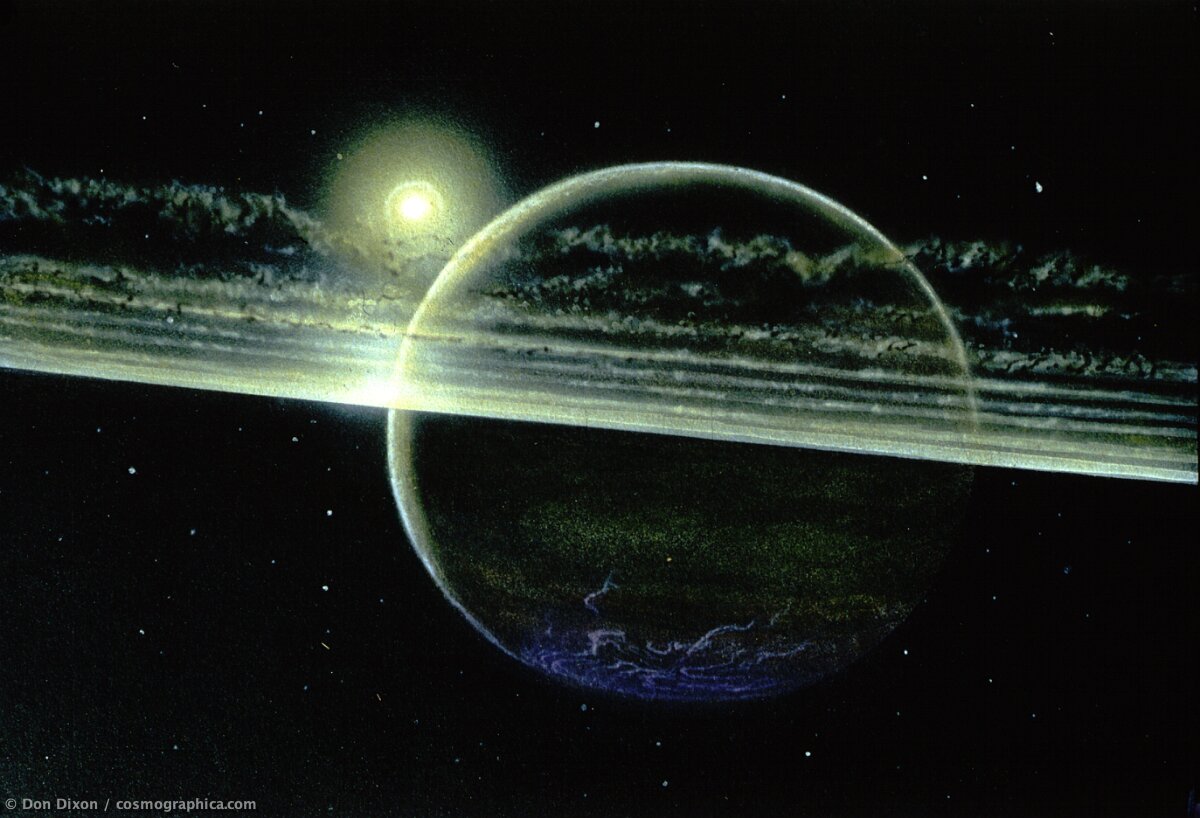
151-f-ring-dixon – A wide-angle view of Saturn and its complex ring system, focusing on the braided and knotted structure of the narrow F ring. The sun appears as a bright, haloed light source, backlighting the delicate dust particles and revealing the intricate, non-uniform bands within the rings. Atmospheric features on the planet’s night side are subtly illuminated by "ringshine."
310-titan-lake-dixon.jpg

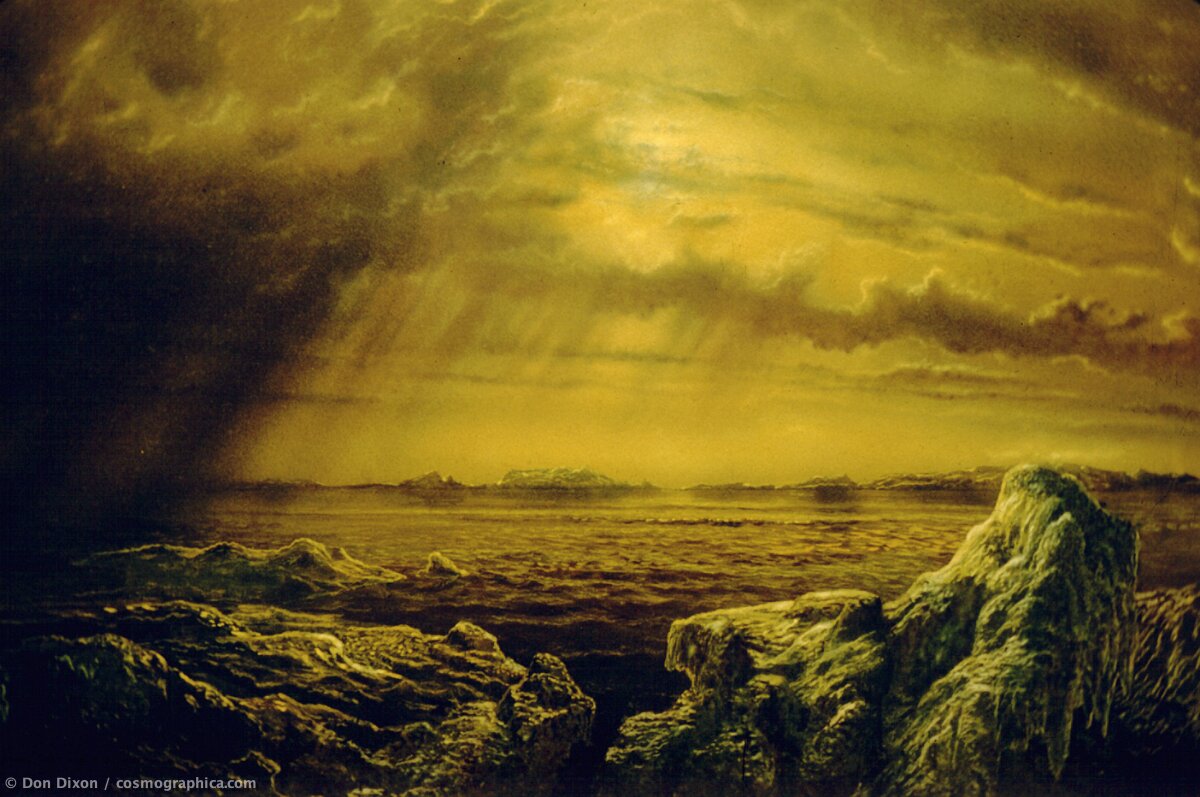
310-titan-lake-dixon –Crepuscular rays pierce through a dense, golden-hued atmosphere to illuminate a vast expanse of liquid methane on Titan's surface. In the foreground, jagged outcroppings of water ice, frozen to the hardness of rock, create a stark shoreline against the ripples of the hydrocarbon sea. A localized storm on the horizon suggests the active methane cycle that shapes the moon's unique, prebiotic environment.
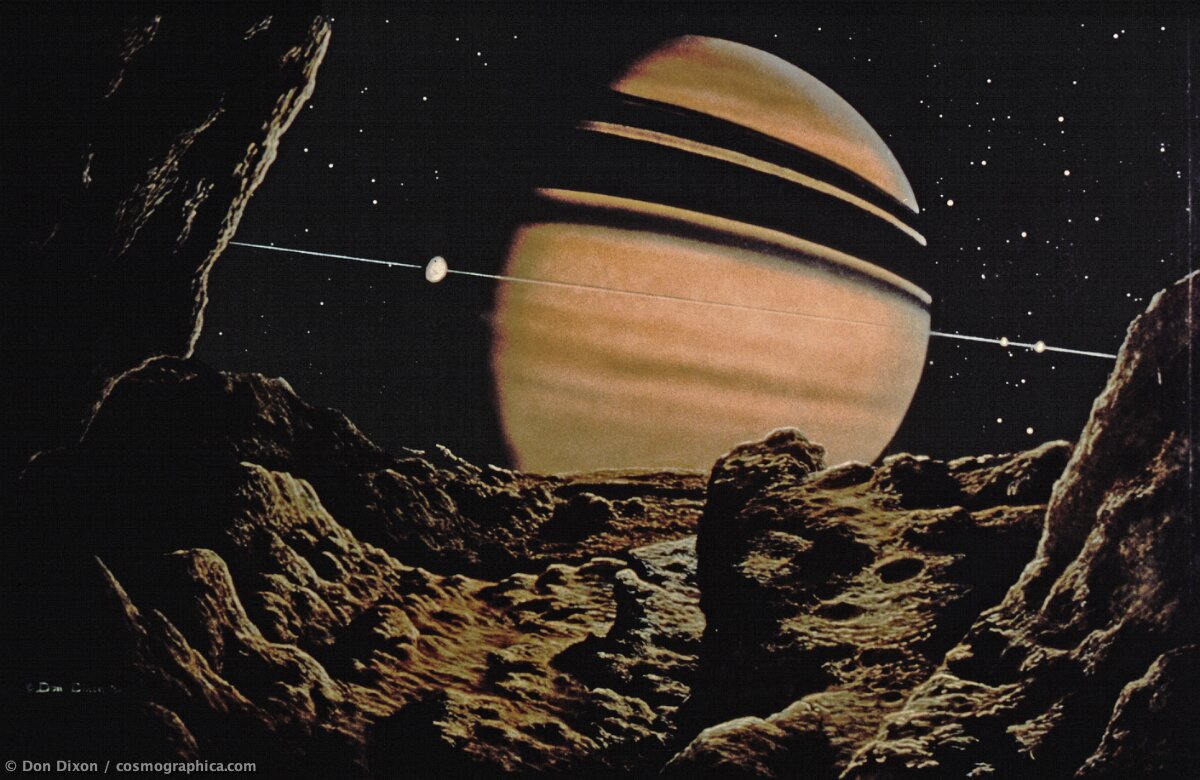
119-saturn-from-rhea-dixon.jpg

119-saturn-from-rhea-dixon – Saturn's inner moons, seen against the thin line of the rings, shuttle like beads on a string. The planet’s rings are seen edge-on as a precise, thin line bisecting the gas giant, while broad, dark ring shadows are cast across the upper northern hemisphere. acrylic on board, 1981
Orbiting Titan
Orbiting Titan
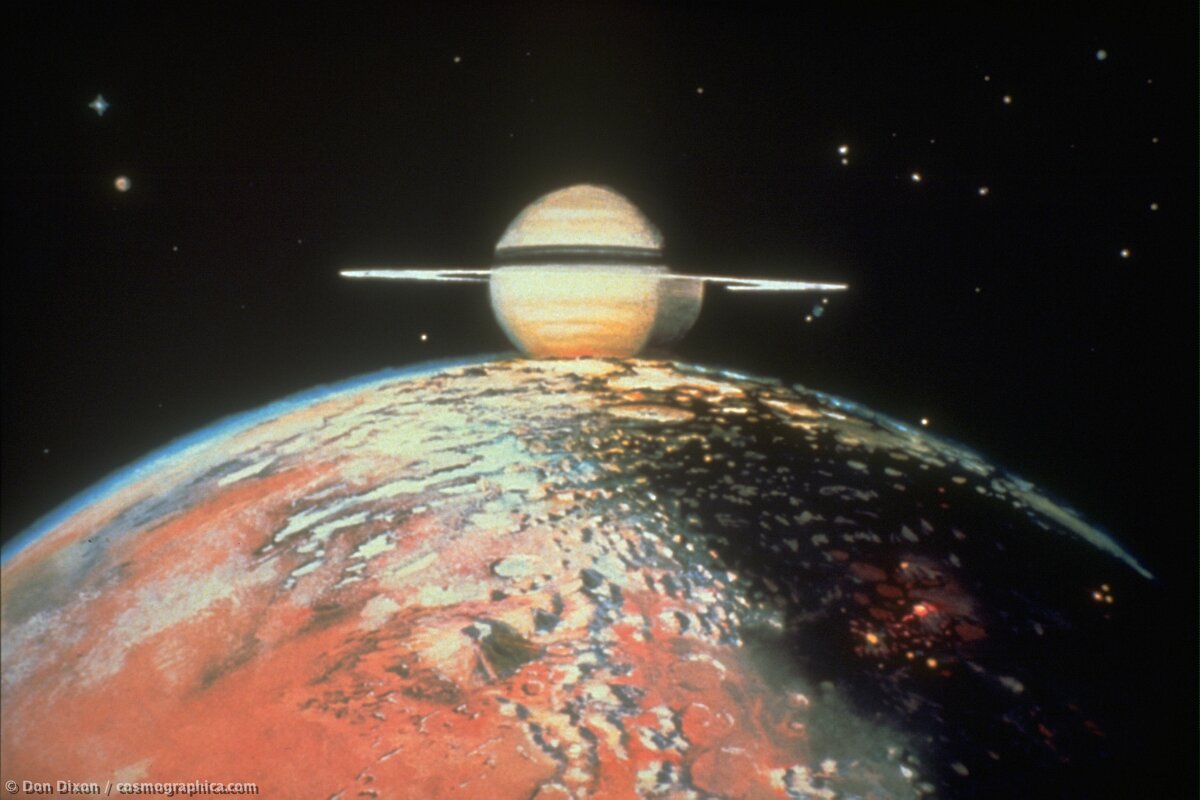
024-orbiting-titan-dixon – Titan depicted as a world warmed by the greenhouse effect, a dated concept. An orbital perspective looking across the curved, hazy limb of Titan toward a distant Saturn. The moon’s surface is a complex tapestry of reddish-orange terrains and dark, low-lying regions, partially obscured by a thin atmospheric blue fringe. Saturn is positioned centrally in the black void, its rings appearing as a brilliant, near-horizontal line with a distinct planetary shadow bisecting the ring plane. Oil on masonite, 1973.
018 The Orbiting Ice
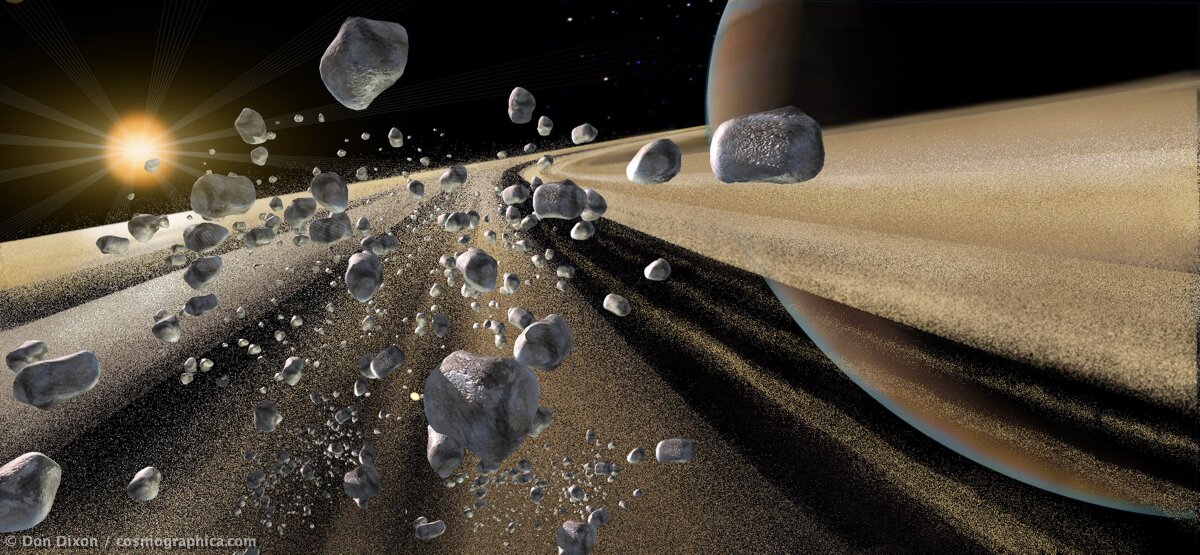
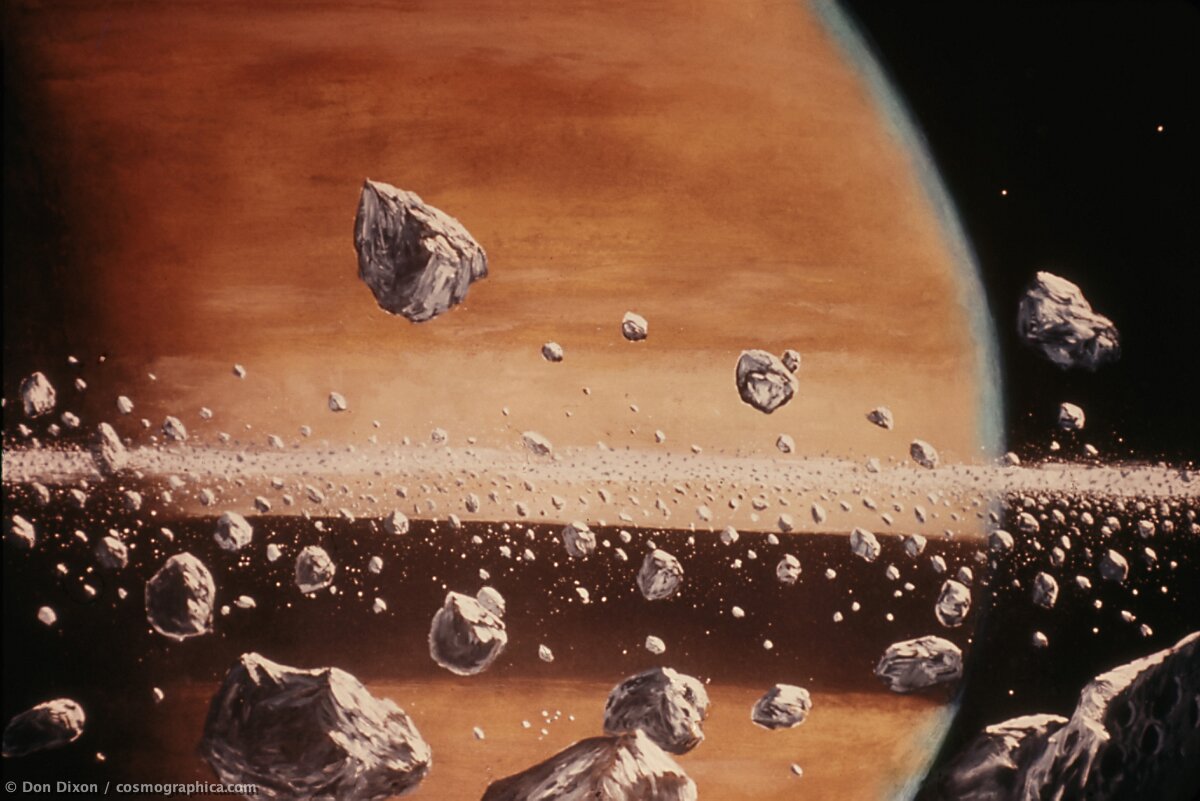
018-orbiting-ice-dixon – Saturn's rings are composed of a myriad particles of ice, ranging in size from pebbles to icebergs,each following its own orbit. Oil on masonite, 1973. © Don Dixon
122-Classical-Titan
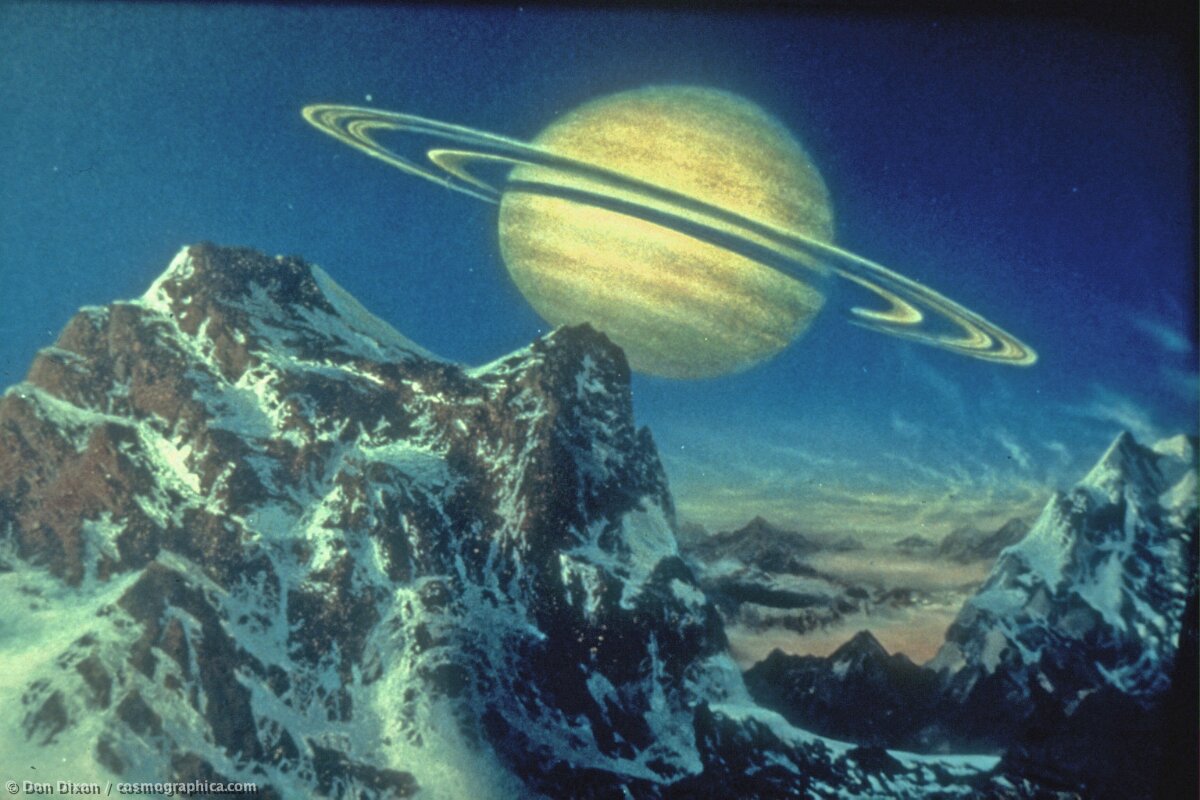
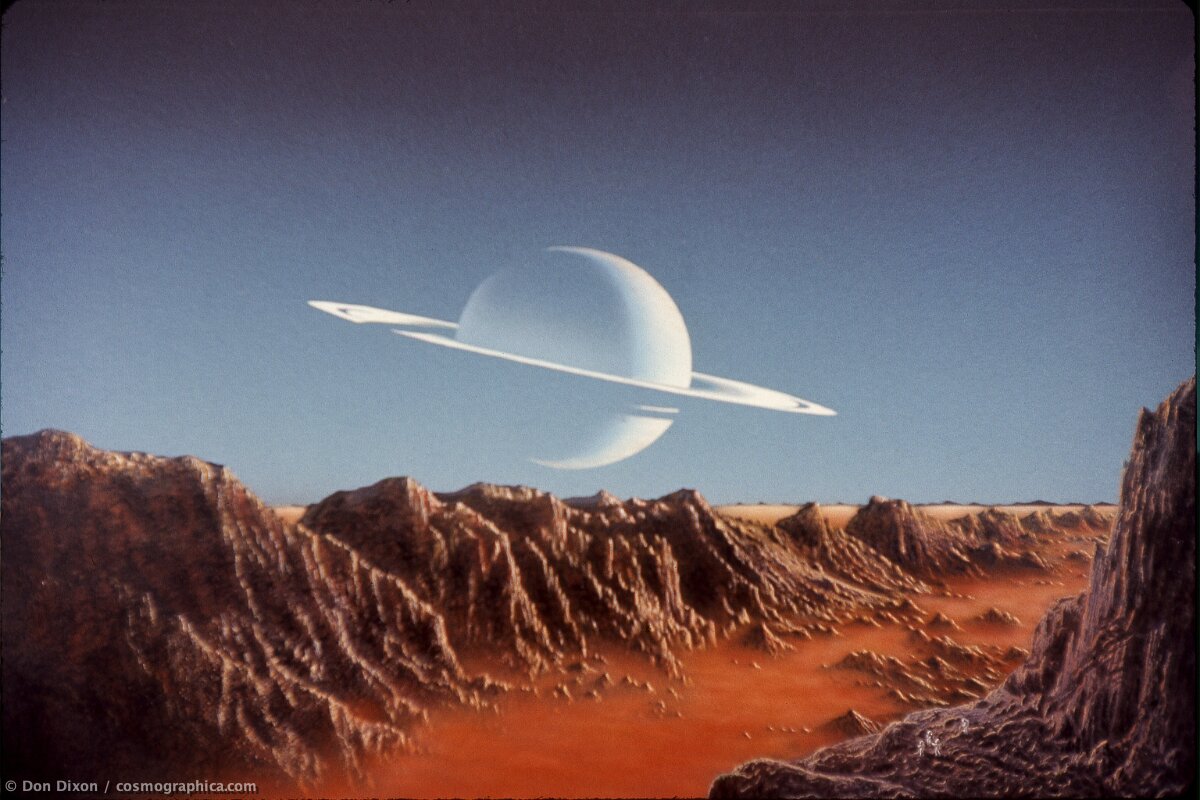
122-classical-titan-dixon – A nostalgic perspective from the surface of Titan, reflecting pre-Voyager scientific models that envisioned a transparent atmosphere. Massive, snow-capped peaks dominate the foreground, looking out toward a large, detailed Saturn suspended in a deep blue sky. This illustration captures a "classical" era of planetary art, emphasizing sharp geological textures and a vivid, clear-sky vista of the gas giant and its rings. Acrylic on illustration board, 1979
264-clouds-of-saturn-dixon
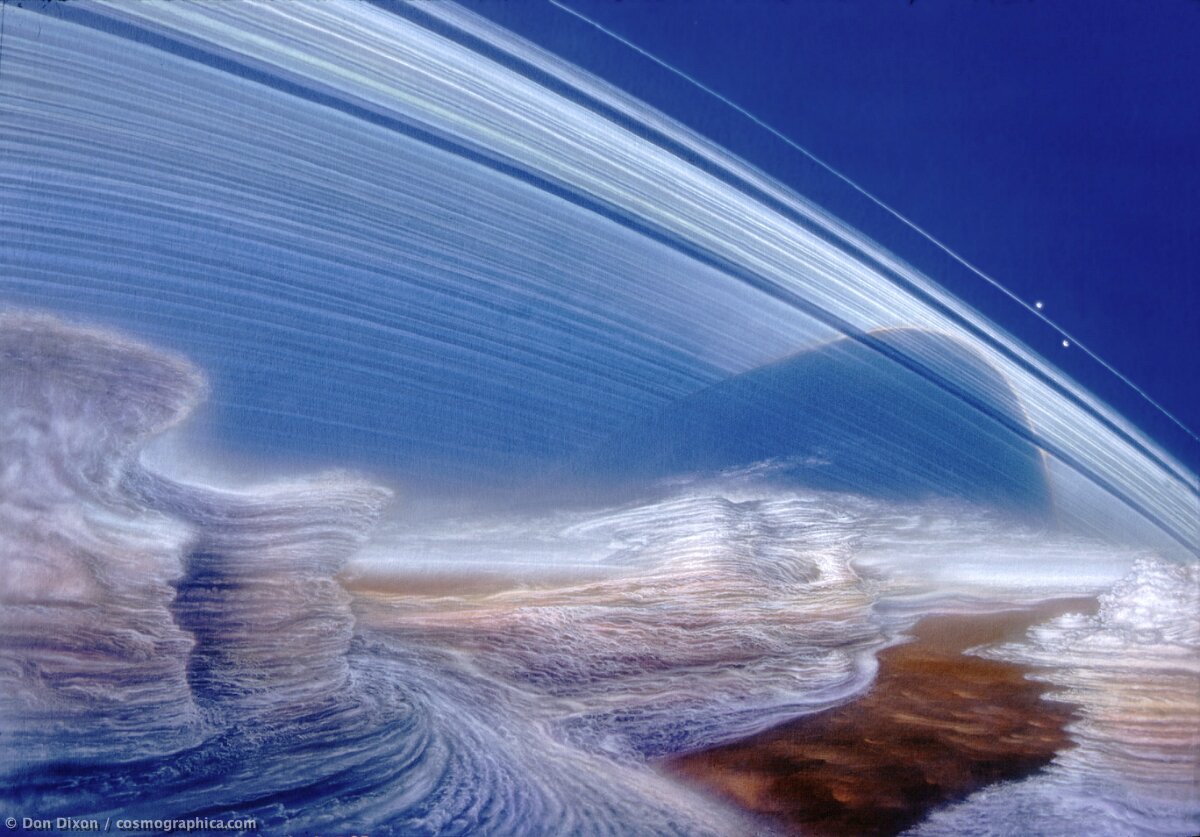
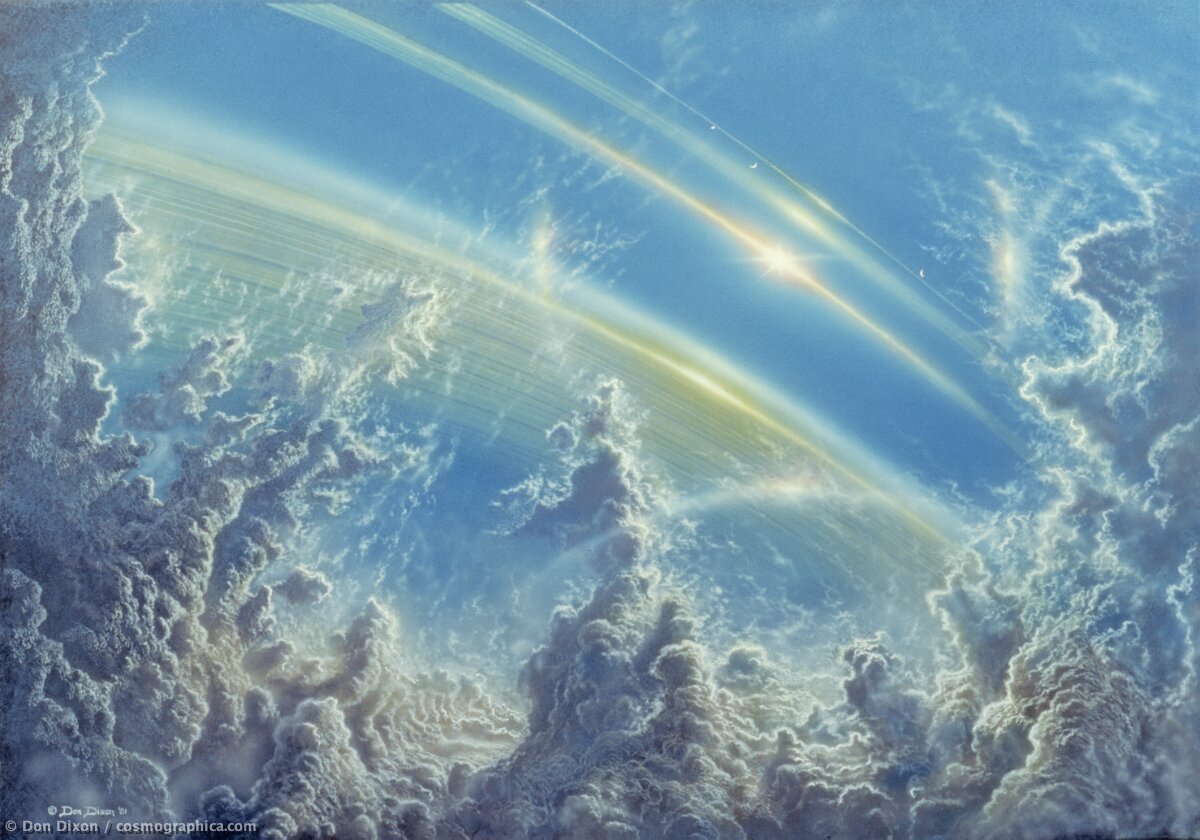
264-clouds-of-saturn-dixon–From deep within the high-altitude haze of Saturn's upper atmosphere, the planet's vast ring system arcs across a brilliant indigo sky. Ammonia ice clouds form delicate, swirling structures in the foreground, catching the pale sunlight and casting soft shadows over the deeper atmospheric layers. Two small moons appear as sharp pinpoints of light near the edge of the ring plane, emphasizing the immense scale and complexity of the gas giant's environment ; acrylic on board, 1990
333-titan-clouds-dixon
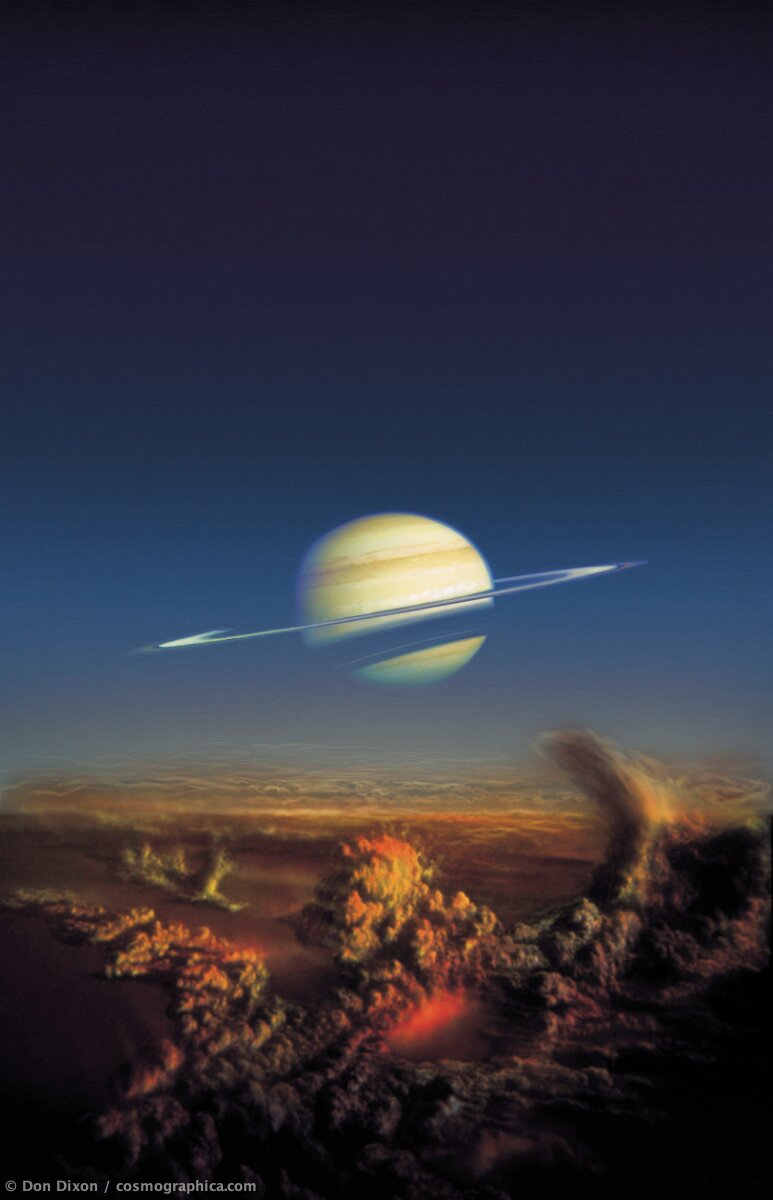
333-titan-clouds-dixon –Saturn hangs serenely above towering methane storm clouds rising above the dark, liquid hydrocarbon seas of Titan, illuminated by a low, distant sun. In the upper atmosphere, the thick nitrogen-rich haze transitions into a deep indigo sky where Saturn hangs as a pale, ringed globe. The scene captures the high-energy weather systems of the Saturnian moon, highlighting the dramatic contrast between its dense lower atmosphere and the vacuum of space beyond. cover for Scientific American Cosmos - painting by Don Dixon
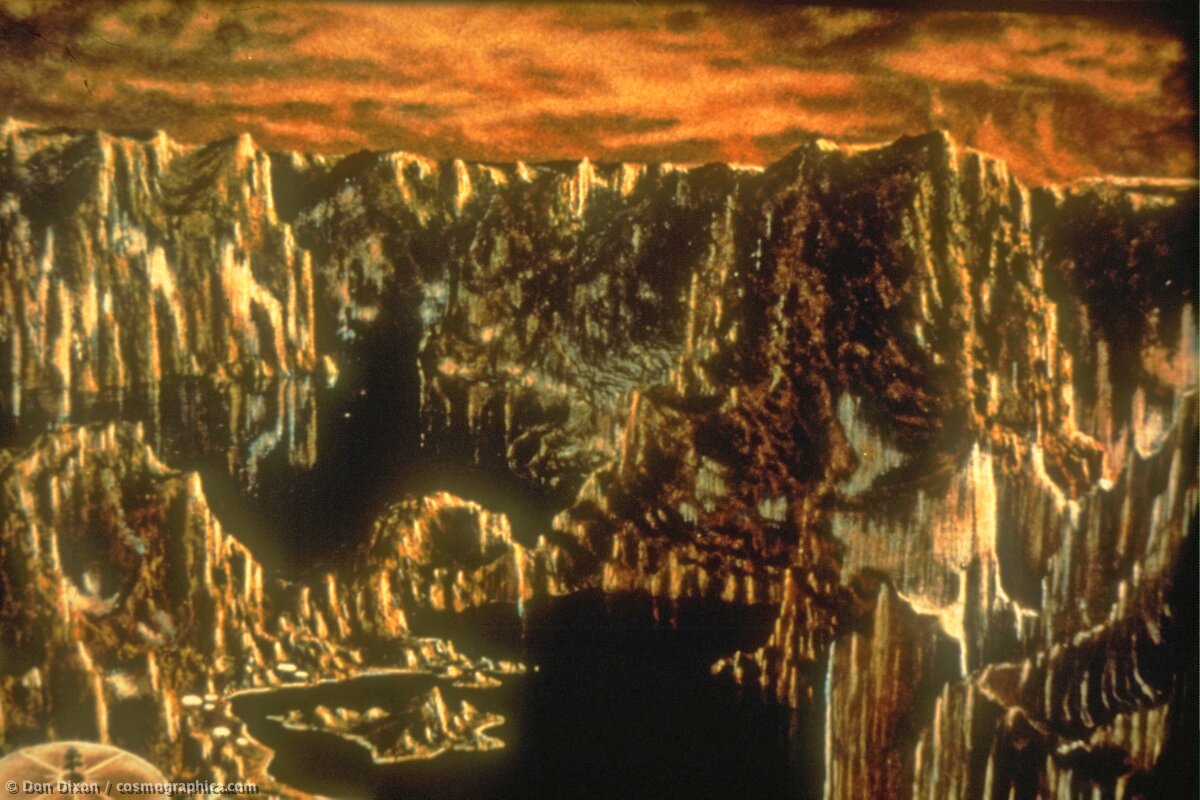
091-ice-cliffs-on-titan-dixon – pools of hydrocarbons nestle between highly eroded cliffs of ice on Titan. Detail from Don Dixon's first published work, the cover of Family Weekly. Featured in Carl Sagan's TV series Cosmos. gouache on board, 1974
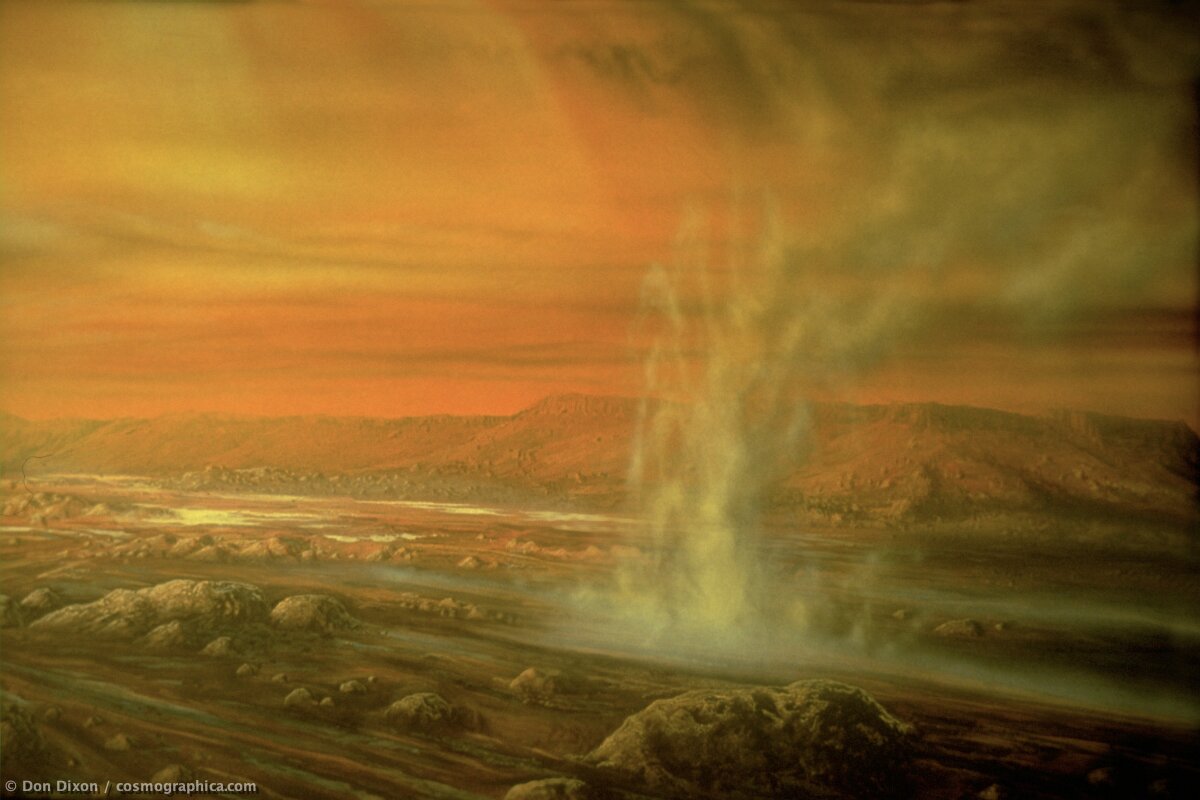
154-titan-geyser-dixon – A cold, hazy landscape on Saturn’s moon Titan depicts a cryovolcanic plume erupting from a rocky, ice-strewn surface. The thick orange-gold atmosphere obscures the distant horizon while casting a diffused light over the low hills and frozen plains. This illustration captures the speculative geology of the moon's methane-rich environment and hydrocarbon cycle., gouache on illustration board, 1974
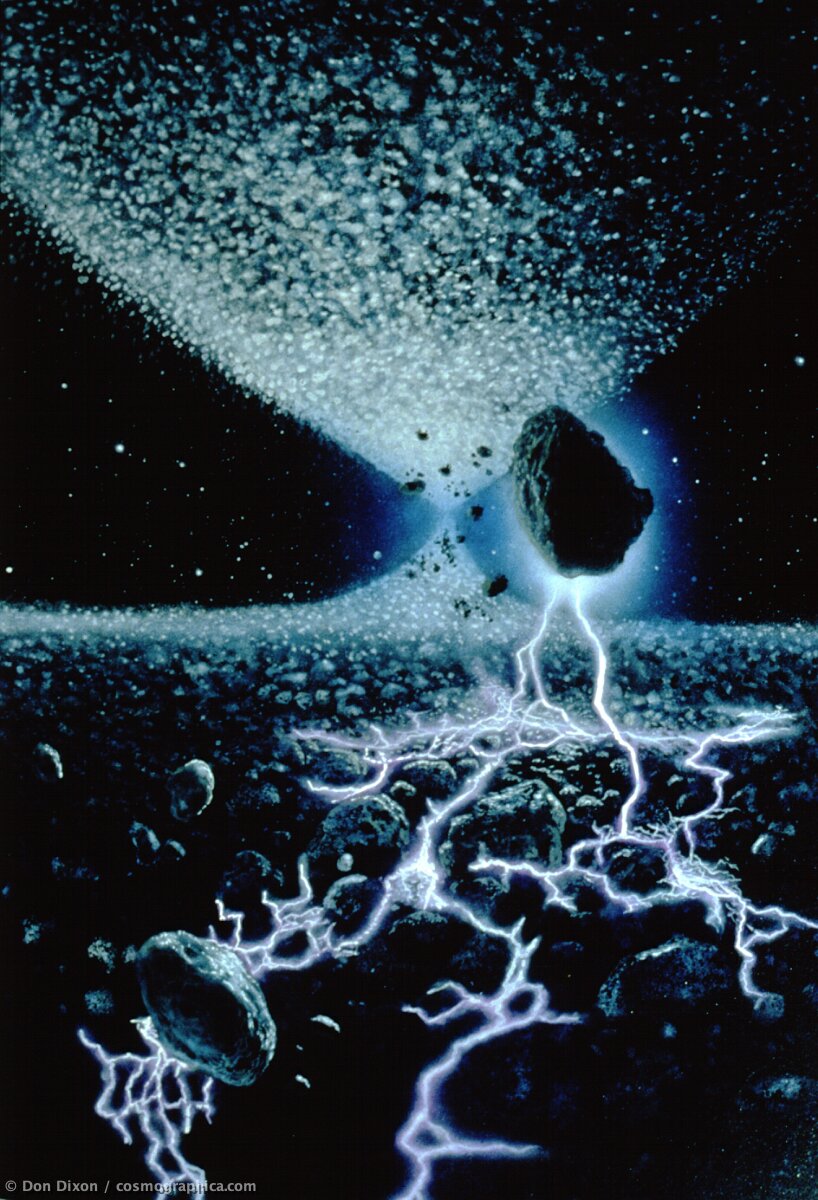
152-electric-moon-dixon –An energetic visualization of electrostatic discharge or plasma phenomena occurring within a planetary ring system or debris disk. Dramatic electrical arcs bridge the gap between irregular, jagged moonlets and a dense field of smaller particulates. The composition highlights the high-energy interactions and electromagnetic forces that can influence the structural dynamics of orbiting celestial bodies.
Iapetus
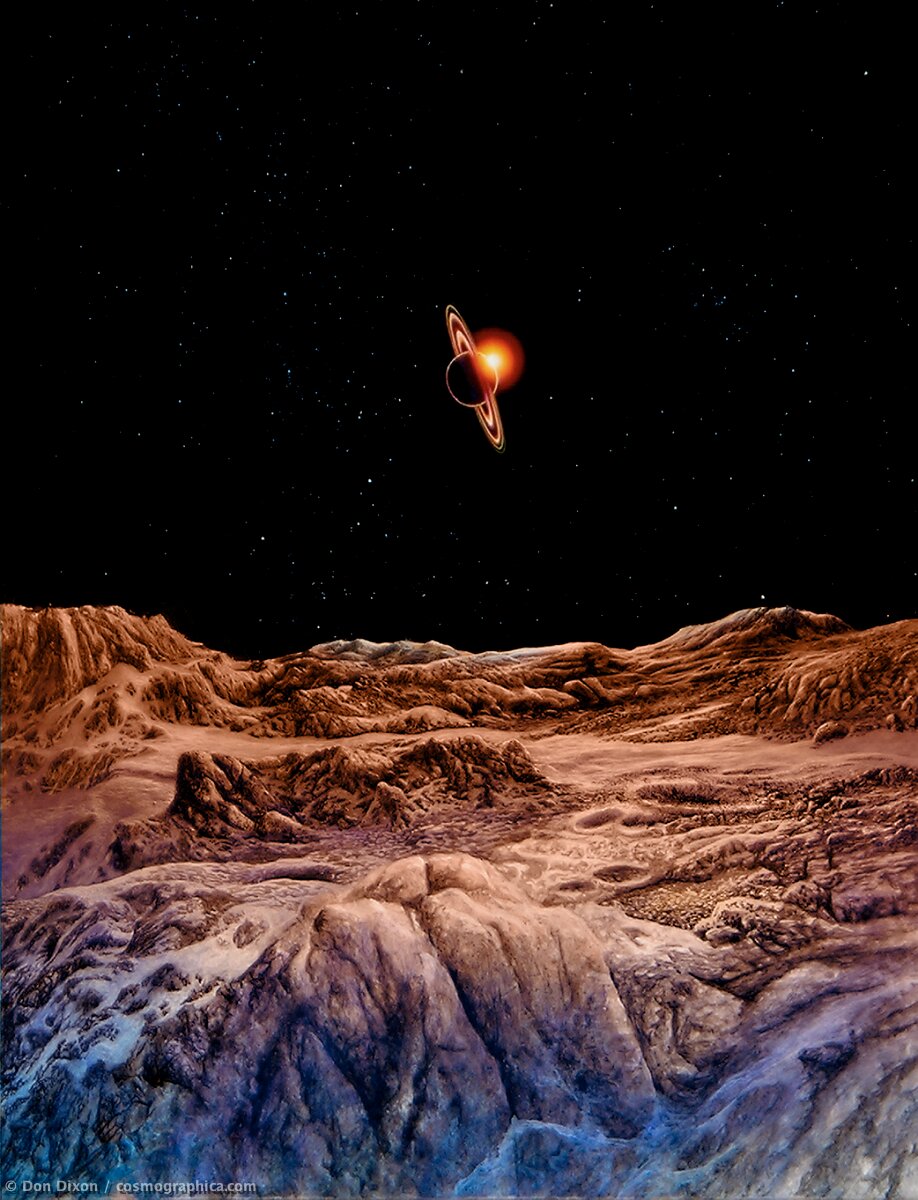
472-iapetus-study-dixon.jpg –Saturn produces a "diamond ring" effect as it eclipses the sun in this perspective from the satellite Iapetus. From the rugged, cratered surface of the moon Iapetus, Saturn appears as a distant, ringed jewel suspended in the absolute blackness of space. The perspective highlights the moon's unique topography, characterized by ancient, icy ridges and a dual-toned surface texture., acrylic, gouache, and oil glaze on illustration board, 48x35 cm, 1984. Collection of Paul Allen Family Trust
148-exploring-saturn-dixon – A cinematic conceptual scene depicting human exploration within Saturn's ring system. Two astronauts in heavy extravehicular activity (EVA) suits navigate a dense field of icy ring particles and larger boulders, while a spacecraft maneuvers nearby against the backdrop of the gas giant's banded atmosphere. The illustration emphasizes the immense scale of the planetary environment and the technical challenges of orbital operations in high-particle environments.

395-saturn-glory-dixon. – The sun blazes through the Cassini Division of Saturn's Rings as viewed from 5,000 miles below the C Ring. Ilustration for Scientific American, March, 2002. The satellite Mimas is visible slightly right and below center.

390-encke-gap-dixon – A cluster of icy satellites have been perturbed into a temporary orbit a few thousand miles above the plain of Saturn's rings. Tenuous rings follow intertwined paths within the Encke Gap far below.- painting by Don Dixon for Scientific American

406-huygens-titan-descent –The Huygens probe drifts through Titan's opaque, amber-hued atmosphere, supported by its pilot chute during the initial stages of its 2005 descent. Motion blur in the lower cloud deck suggests high-altitude winds, while the distant, ringed silhouette of Saturn serves as a celestial anchor in the hazy sky. The illustration captures the transition from the vacuum of space to the dense, hydrocarbon-rich environment of Saturn’s largest moon. Digital, for Scientific American, 2004
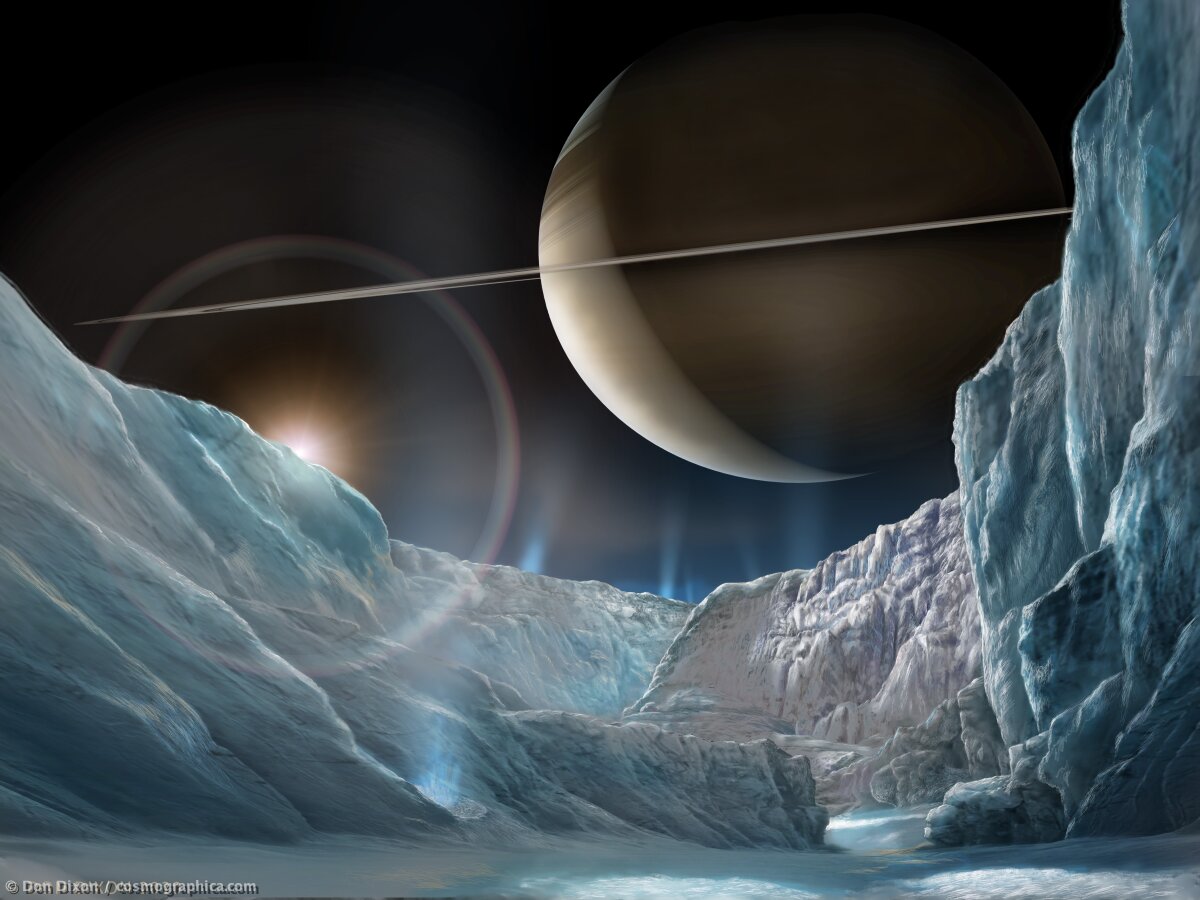
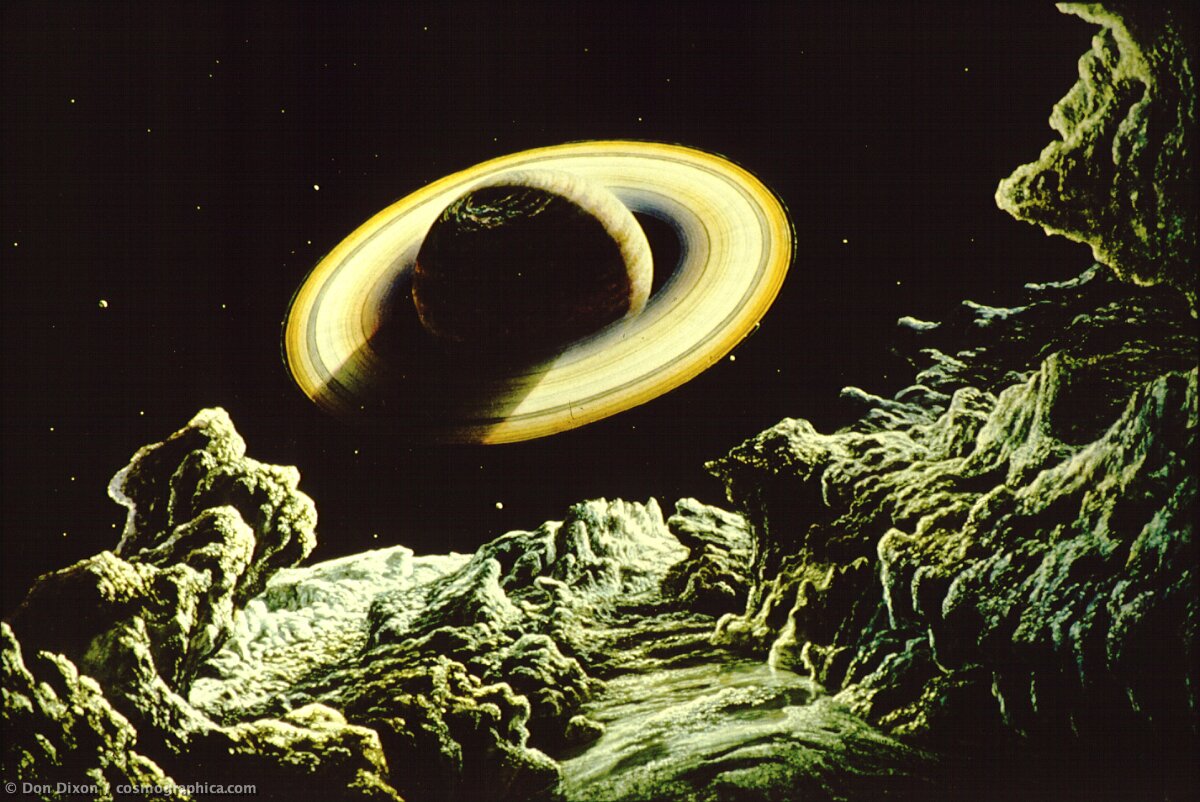
Saturn seen from Enceladus
550-saturn-from-enceladus.jpg – The ringed planet Saturn looms over the jagged, icy horizon of its moon Enceladus. Erupting cryovolcanic plumes are visible in the foreground, venting water vapor and ice particles from the moon's subsurface ocean into space. The Sun appears as a bright source behind the icy ridges, creating a pronounced lens flare and illuminating the fine structure of Saturn's rings seen at a high inclination.
146-saturn-from-comet-dixon – A dramatic view from the irregular, craggy surface of a comet nucleus as it passes through the outer Saturnian system. The gas giant is positioned centrally, showcasing its broad ring system and the shadow of the planetary sphere cast upon the rings. The foreground features highly textured, porous landscape details suggestive of a "dirty snowball" composition, providing a sense of scale to the distant planet.
Sunrise on Titan, 1971
003-sunrise-on-titan-dixon – Saturn's rings poised vertically as seen from Titan's equator; oil on panel, 1971. At the time, Titan was believed to have a tenuous methane atmosphere which might afford a spectacular view of Saturn.
View from Iapetus
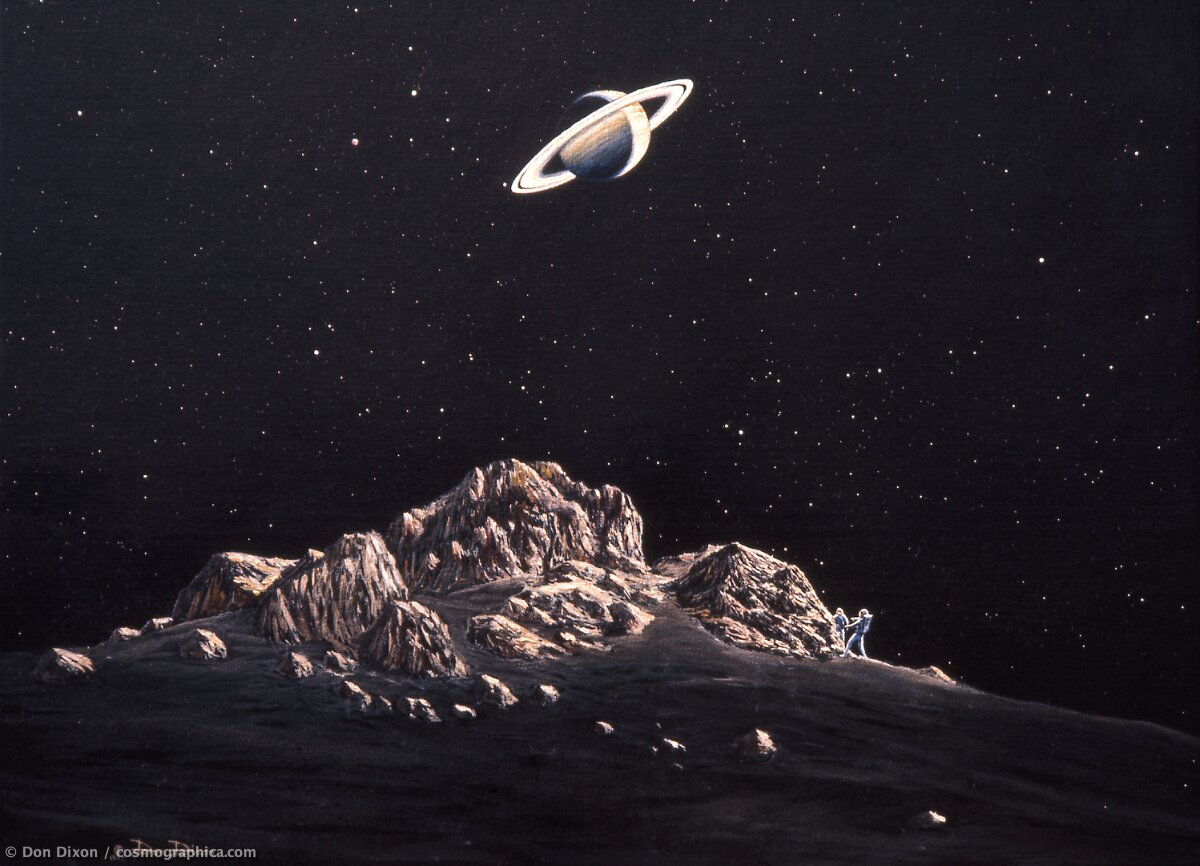
013-view-from-iapetus-dixon – This classic illustration depicts a stark, rocky ridge on the surface of Saturn's outer moon Iapetus, looking out into deep space. Two astronauts in pressure suits stand near a rugged crag in the foreground, establishing a sense of scale against the vast, star-filled void. High above the horizon, Saturn hangs prominently with its ring system highly inclined, displaying a distinct shadow cast by the planet's globe onto the rings. Oil on panel, 1968
049-titan-1-dixon. – Titan rendered with a deep blue sky. At the time this was painted, hints of an orange haze had been detected. It is shown here as a fog that fills valleys. (Dated concept). Gouache on illustration board, 1976. © Don Dixon

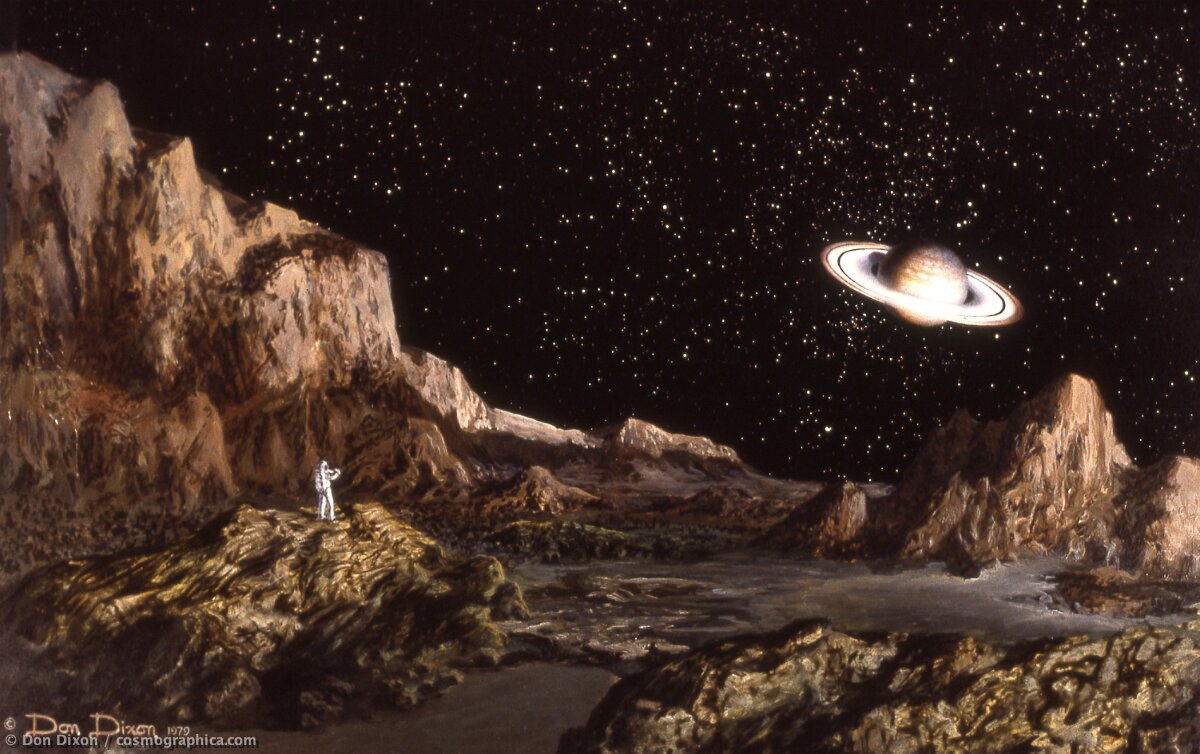
198-exploring-iapetus-dixon – A lone astronaut stands upon a rocky outcropping on the surface of Iapetus, surveying the desolate, cratered landscape of Saturn’s third-largest moon. The distant gas giant hangs prominently in a dense field of stars, its rings tilted to reveal the planet's southern hemisphere. This composition highlights the contrast between the scale of human exploration and the vast, silent reaches of the outer solar system. Acrylic, 1979.
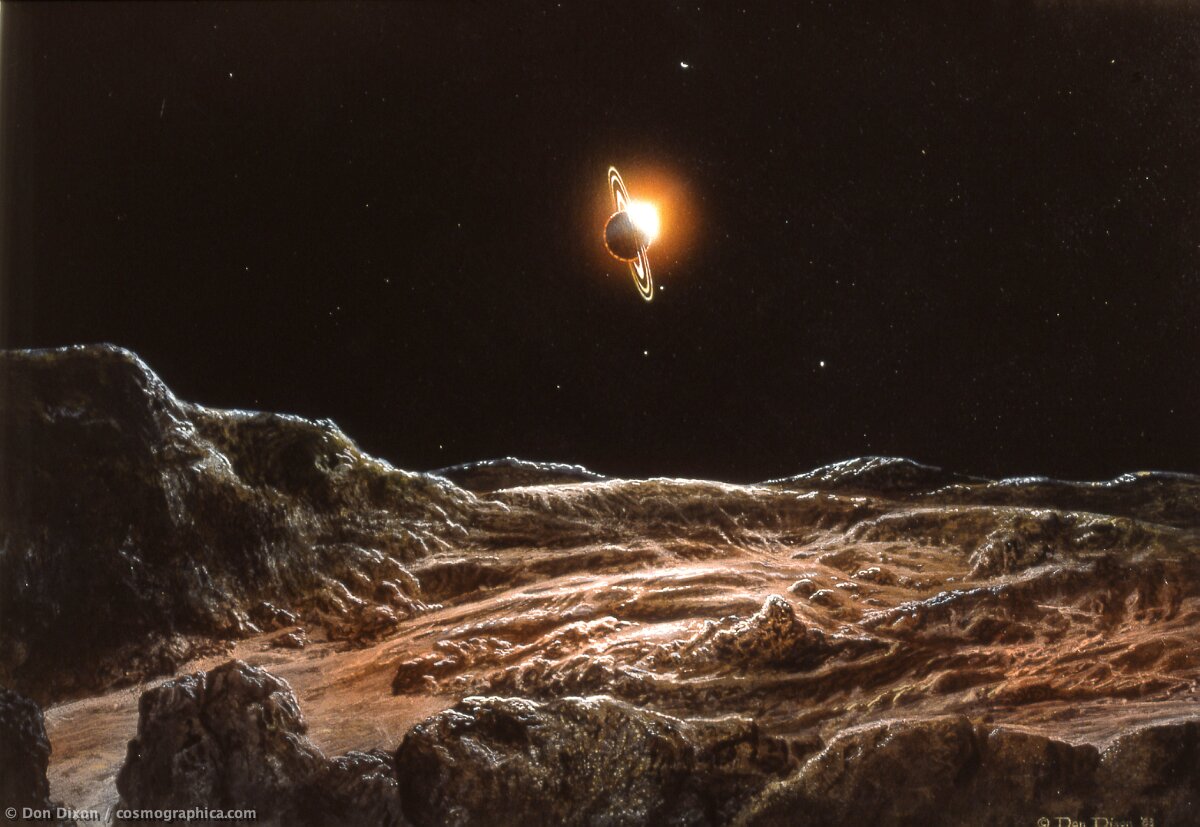
156-eclipse-by-saturn-dixon –From the rugged, airless surface of the small outer moon Iapetus, the Sun is momentarily eclipsed by the massive disk of Saturn. The solar corona flares out from behind the planet's limb, illuminating the delicate, multi-layered rings in a brilliant golden fire. The cratered landscape in the foreground is cast in deep shadow, punctuated only by the reflected "ring-shine" that softly reveals the texture of the ancient, rocky terrain.
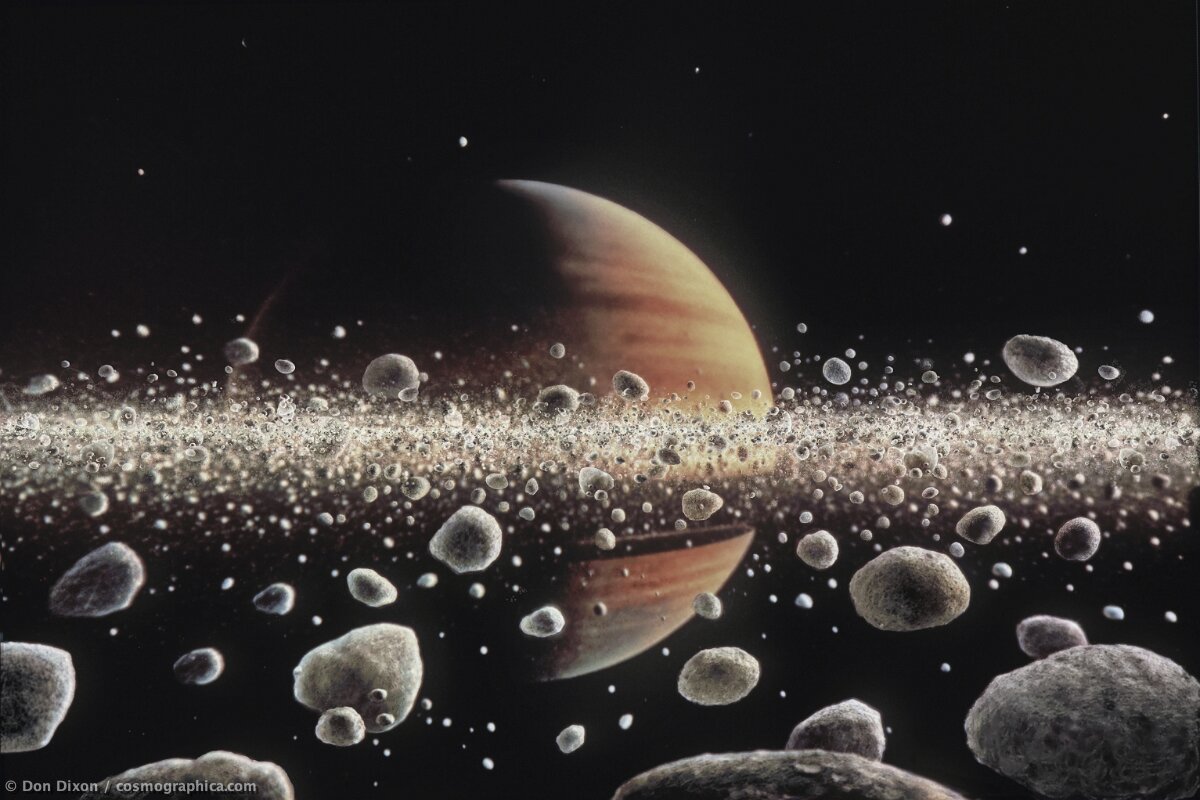
050-saturn-rings-dixon – a close-up, internal perspective from within the ring system of Saturn, looking back toward the gas giant. Countless individual ring particles, ranging from small boulders to fine icy dust, are depicted orbiting in a dense, flat plane, with foreground fragments rendered in sharp detail showing irregular, cratered textures. Saturn itself looms in the background, partially illuminated by sunlight, with its banded atmosphere visible through the transparent gaps in the ring plane. acrylic and gouache, 1976, digitally remastered 2026

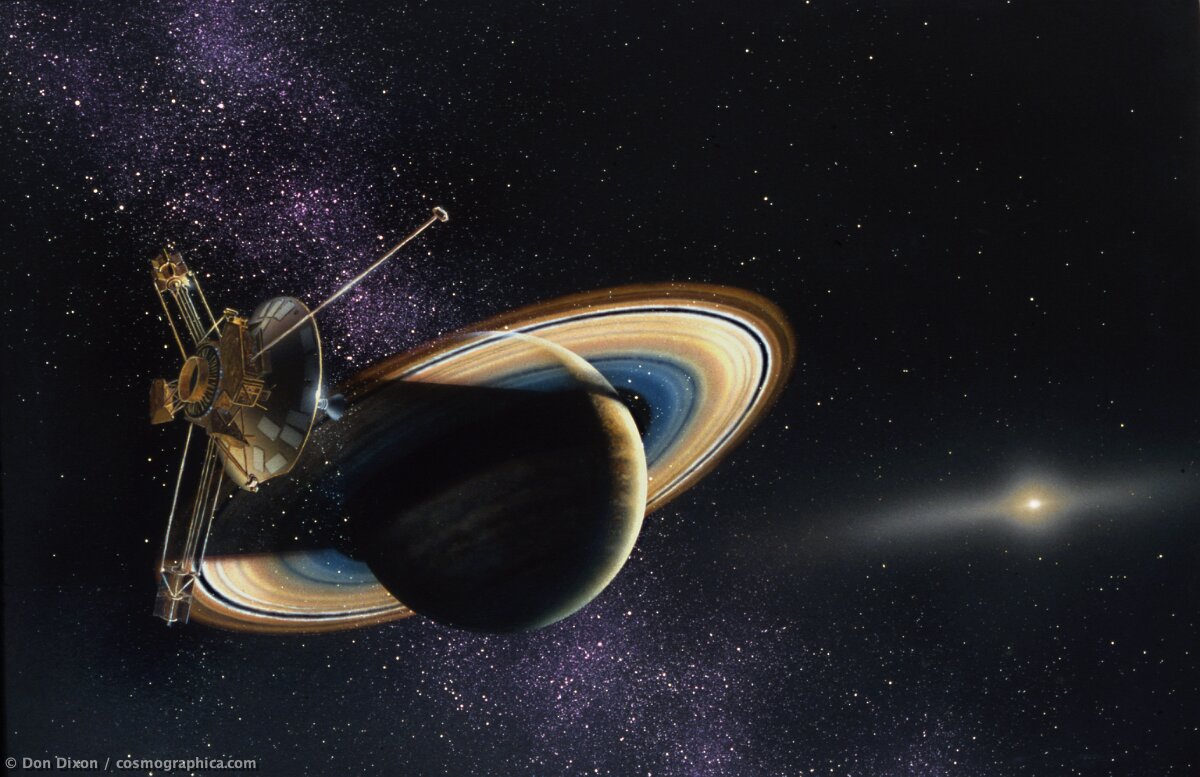
484-pioneer-saturn-1977-dixon.jpg – The Pioneer 11 probe flys past Saturn in this pre-encounter acrylic on board painting dating from 1977. The Pioneer 11 spacecraft is depicted during its historic flyby of Saturn, positioned against the dark, star-dusted backdrop of the outer solar system. The gas giant's complex ring system is shown in sharp detail, casting a dramatic shadow across the planet's banded atmosphere. In the distance, the Sun appears as a bright, concentrated point of light, emphasizing the vast, cold distances of the deep space environment.
Terraformed Titan
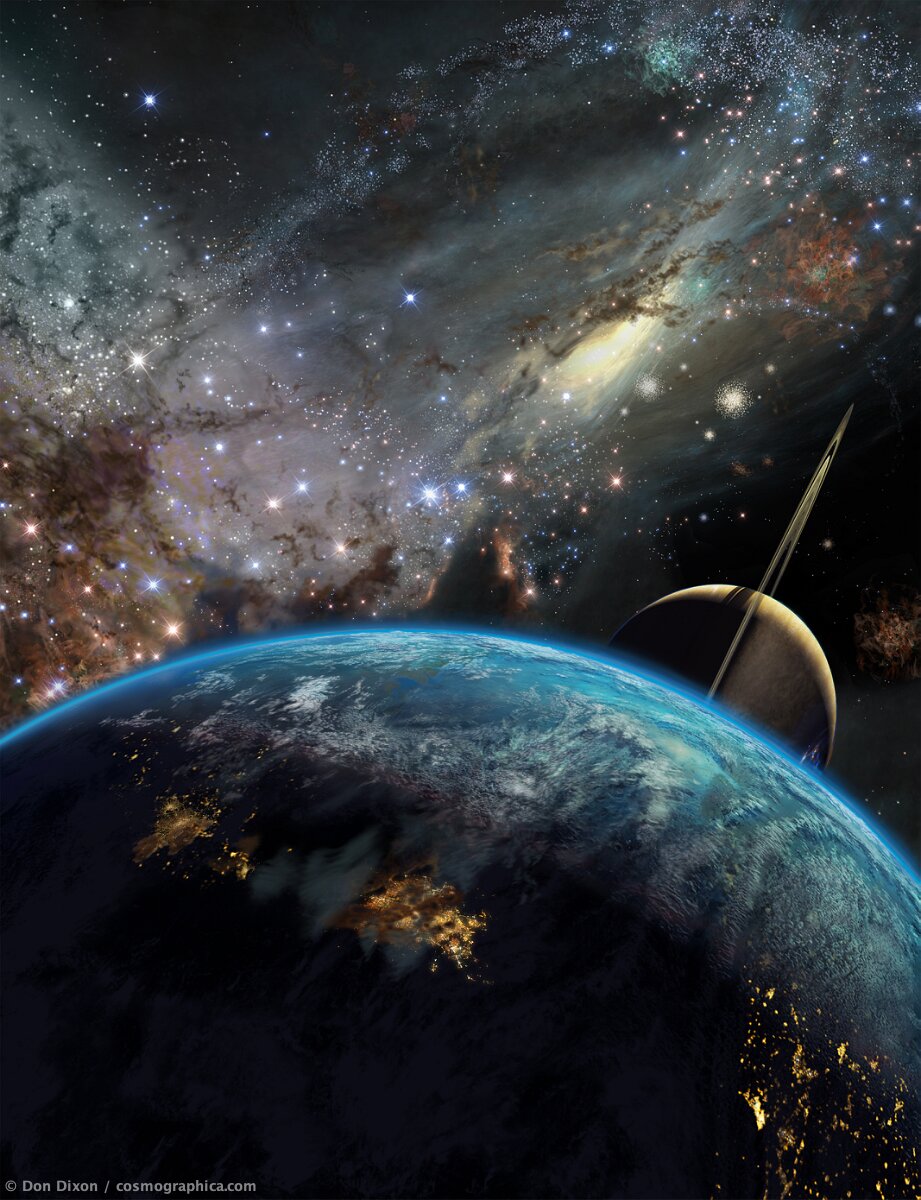
487-terraformed-titan-dixon.jpg – More than 3 billion years in the future, the slow-motion collision between the Andromeda Galaxy and our Milky Way will trigger a spectacular burst of star formation. In this painting, descendants of earth life have colonized Satun's moon Titan, which will warm as the sun ages. Cover painting for Astronomy magazine, April, 2013.

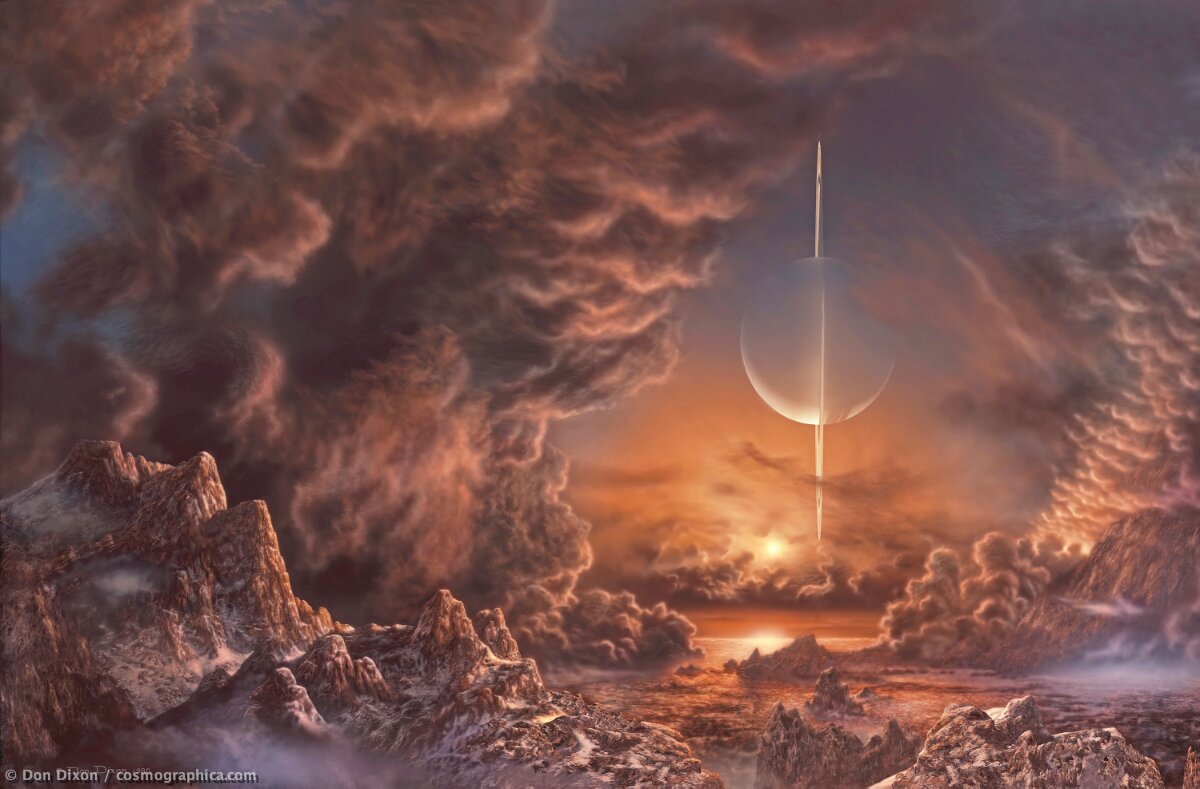
18-titan-dawn-dixon.jpg – The ringed planet Saturn hangs like a shining bow in the sky of its largest moon Titan, which is shrouded in a dense atmosphere of nitrogen hazed by hydrocarbons. Although glimpses of Saturn from the surface are probably exceedingly rare, they are not impossible. Drifts of methane snow blanket the landscape. Originally painted in acrylic and gouache on illustration board in 1980, this image has been digitally restored. copyright 2014 Don Dixon / cosmographica.com
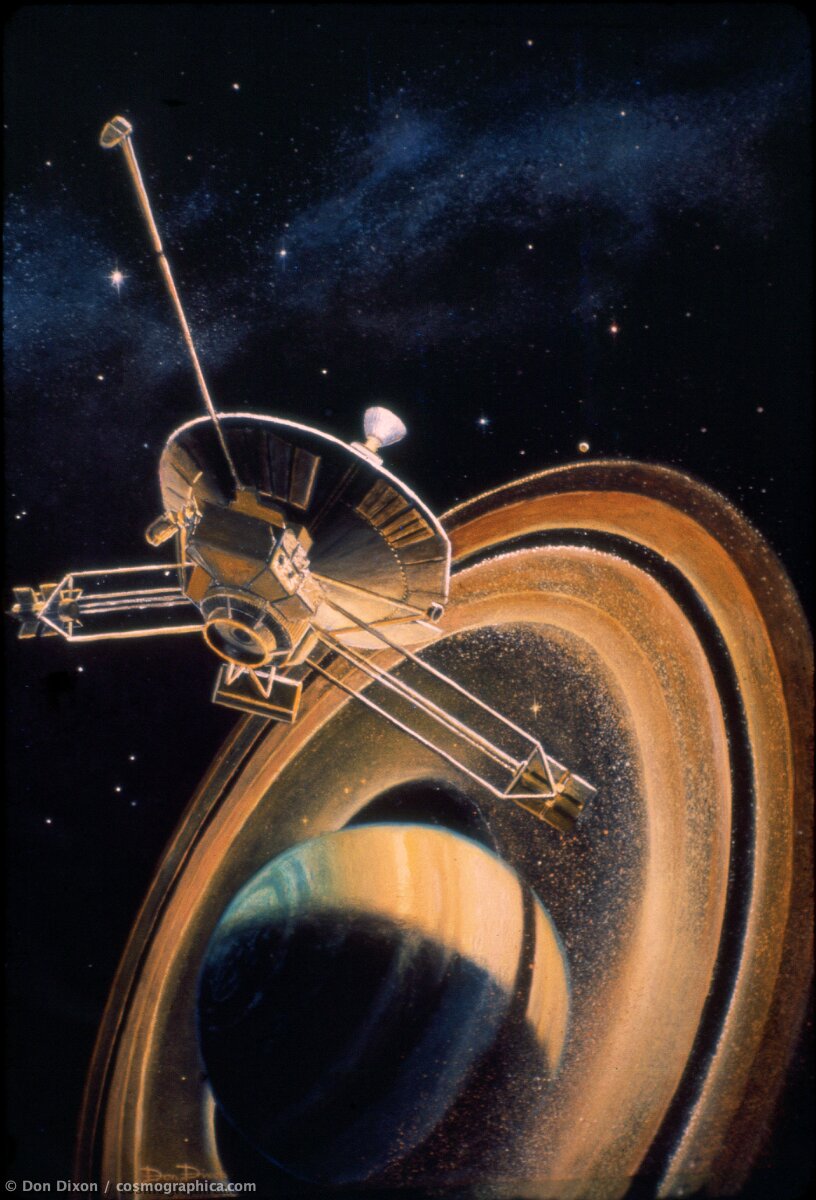
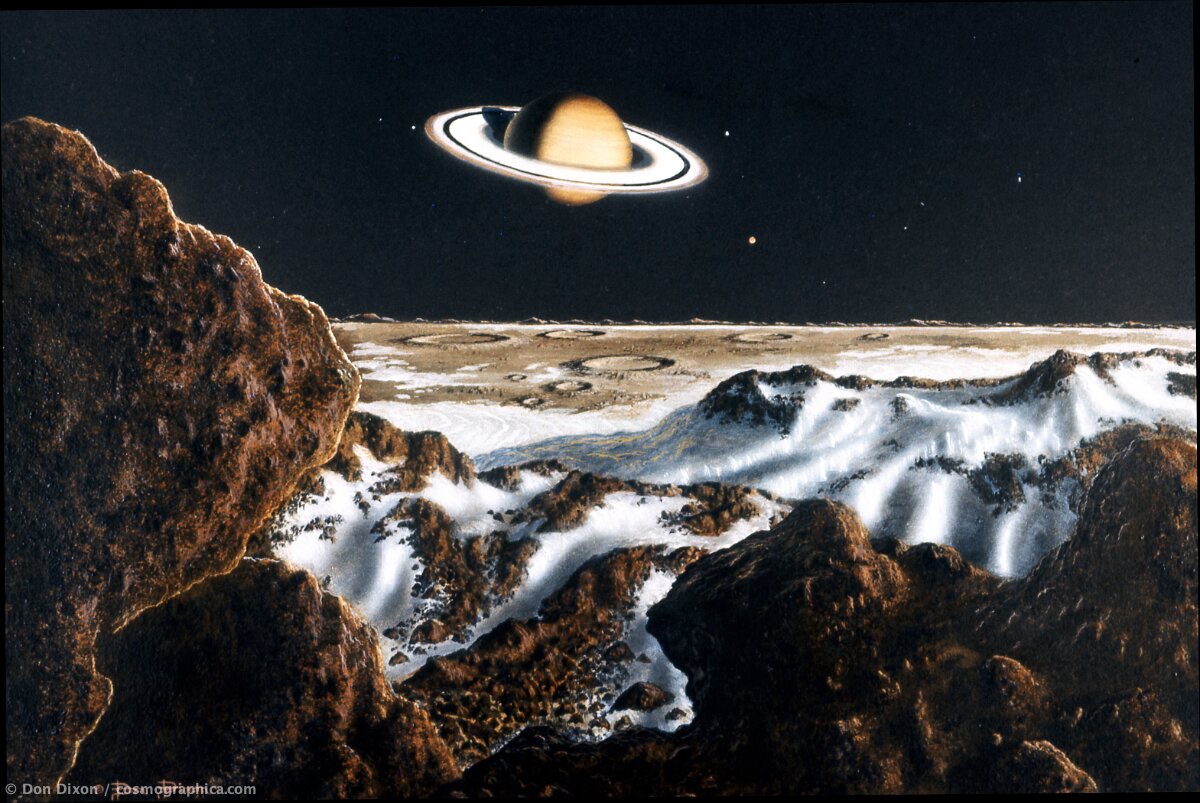
031-saturn-flyby-dixon – The Pioneer 11 probe makes the first reconnaissance of Saturn in 1979. Oil on masonite, 1974. Base art for NASA Saturn Encounter logo.
048-saturn-iapetus-2-dixon– A striking view from the high-latitude, rugged terrain of Iapetus looking toward a distant Saturn. The foreground features steep, dark cliffs and cratered highlands covered in bright frost or ice, illustrating the moon's extreme albedo dichotomy. Saturn is positioned high in the black sky, showcasing its broad ring system and a subtle planetary shadow cast upon the rings, while distant stars and smaller moons dot the void. acrylic and gouache, 1975
117-below-saturns-rings-dixon – A view from deep within Saturn’s upper atmosphere looking upward through layers of ammonia ice clouds toward the ring system. The sun appears as a brilliant point of light, partially diffused by the rings, which span across a pale blue sky in massive, luminous arcs. The intricate cloud structures in the foreground provide a sense of scale and depth within the gaseous environment of the giant planet. The sun blazes briefly through the Cassini Division of Saturn's rings. acrylic on illustration board, 1980

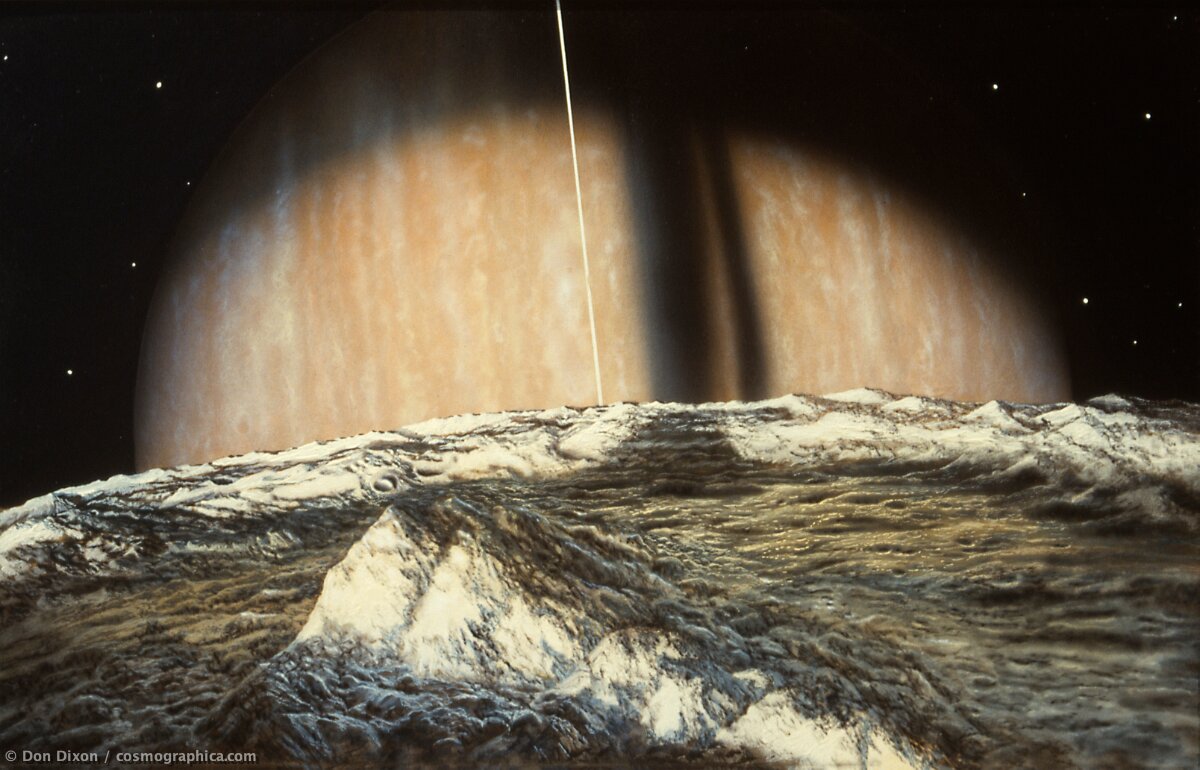
147-mimas-dixon – View from Herschel Crater on the icy, rugged surface of Mimas looking toward a massive, gibbous Saturn. The planet’s rings are seen edge-on as a thin, brilliant line, casting a broad, dark shadow across the gas giant's northern hemisphere.

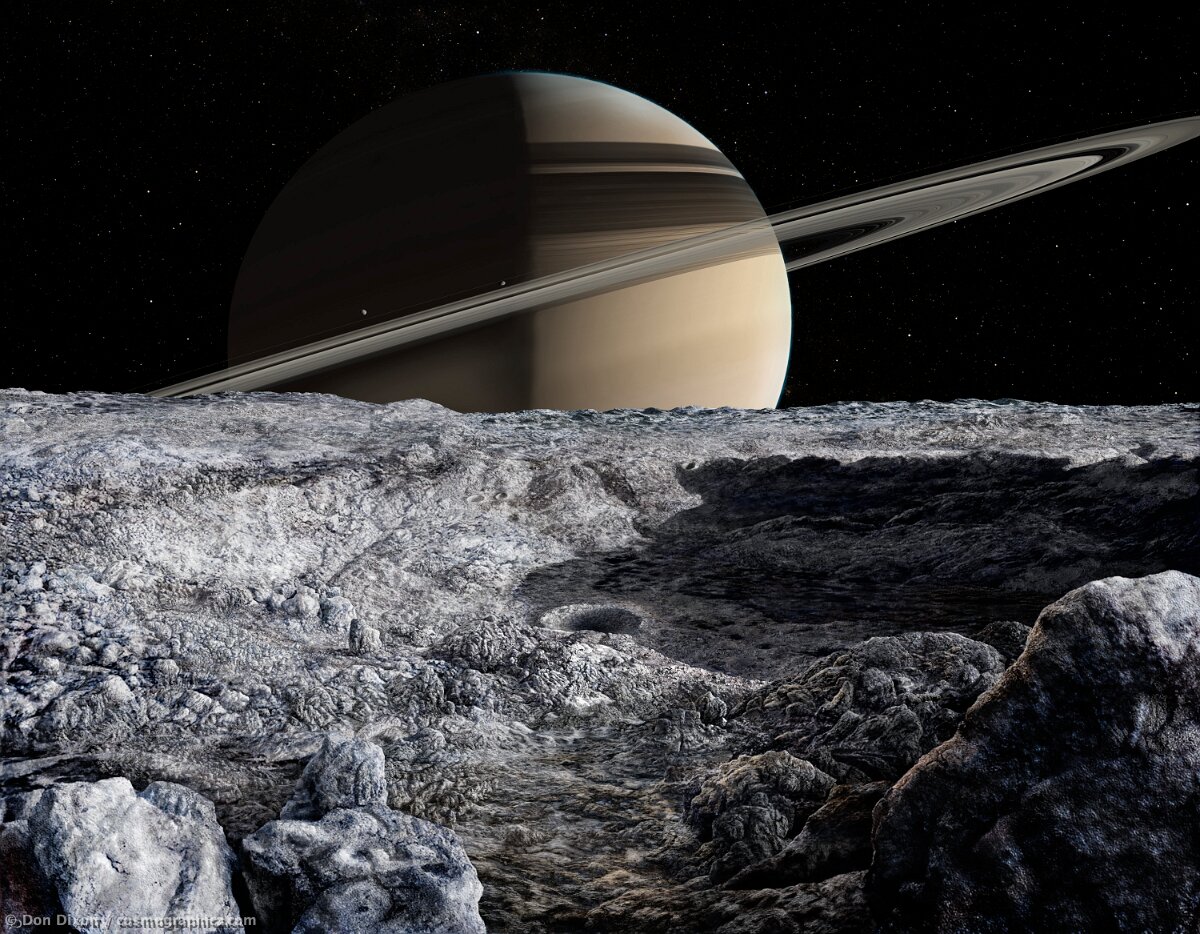
446-saturn-from-mimas-dixon–The massive globe of Saturn fills the sky above the desolate, impact-scarred surface of its moon Mimas. Detailed rock textures and deep shadows emphasize the airless environment of the moon's cratered terrain, while the gas giant's rings cut a sharp diagonal across the frame. Two smaller moons are visible as tiny specks near the ring plane, highlighting the immense scale of the Saturnian system. Commisioned by Griffith Observatory for an exhibit. Digital painting © 2007 Don Dixon/cosmographica.co