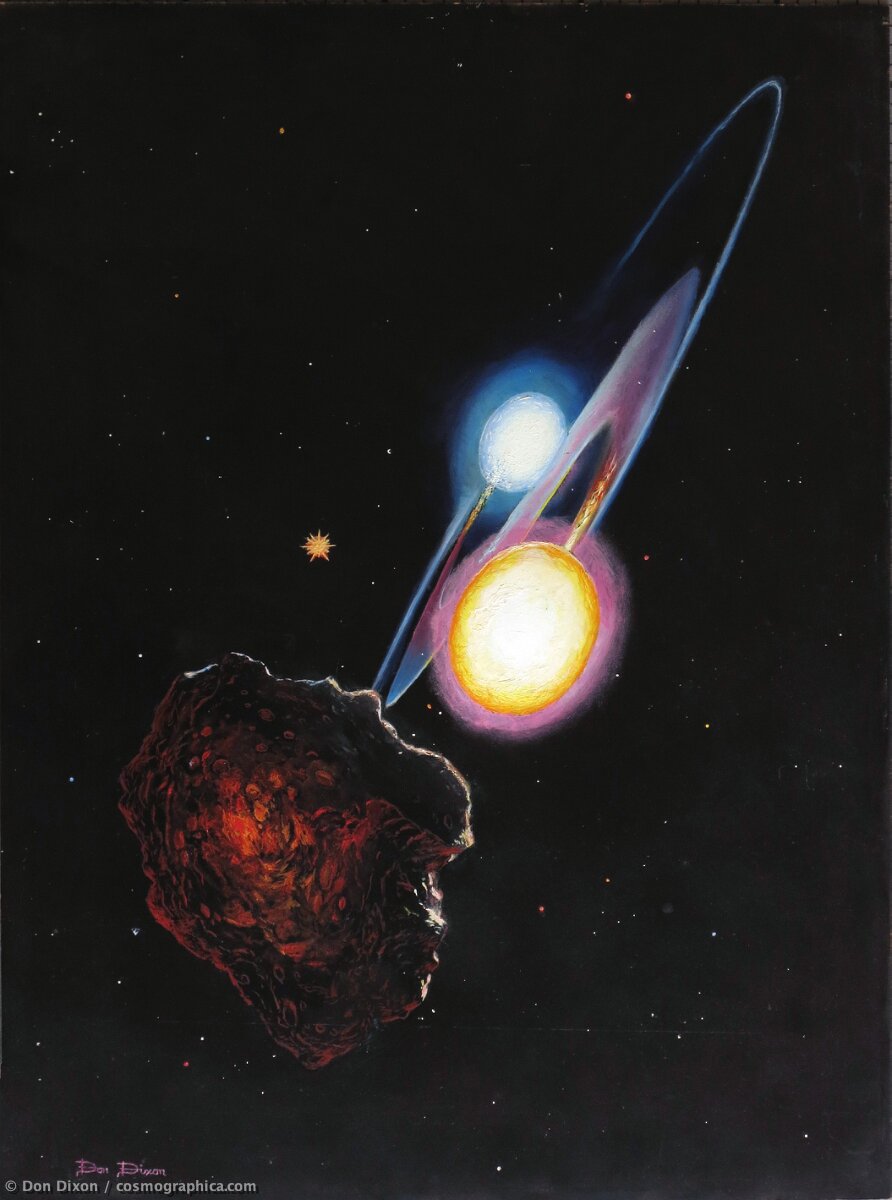
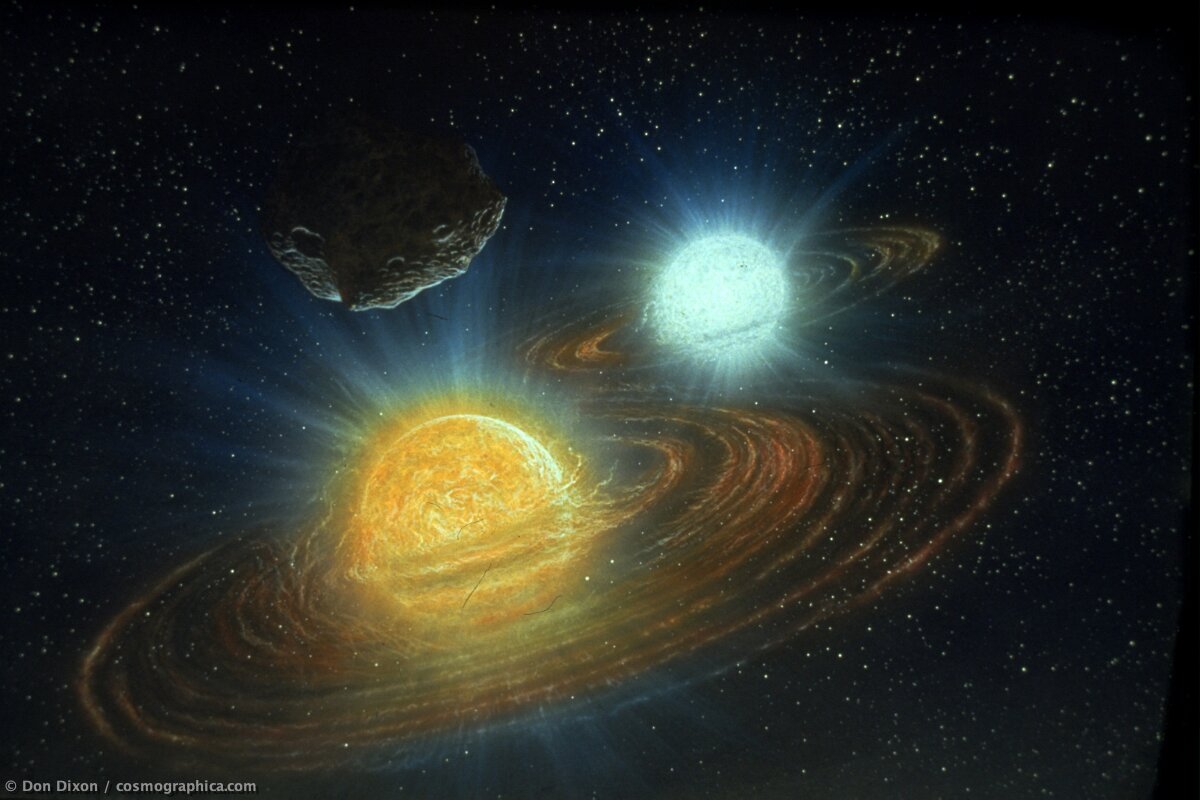
This illustration depicts a close binary star system undergoing stellar mass transfer. A larger, cooler orange subgiant fills its Roche lobe, shedding gas that forms an accretion disk around a more massive, blue-white main sequence star. A foreground irregular asteroid or planetesimal provides a perspective of the orbital plane, while a distant third stellar component is visible in the background.
Oil on masonite, 18x24 inches, 1974. artwork © Don Dixon/cosmographica.com
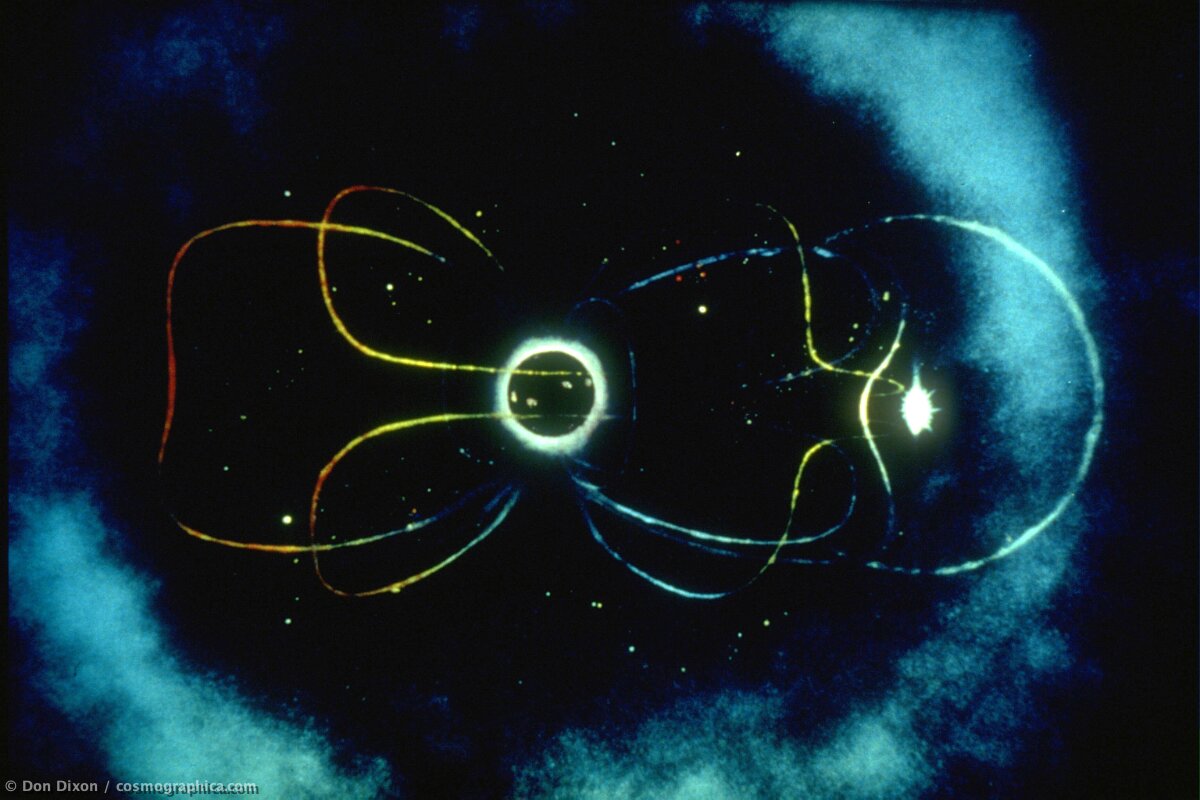
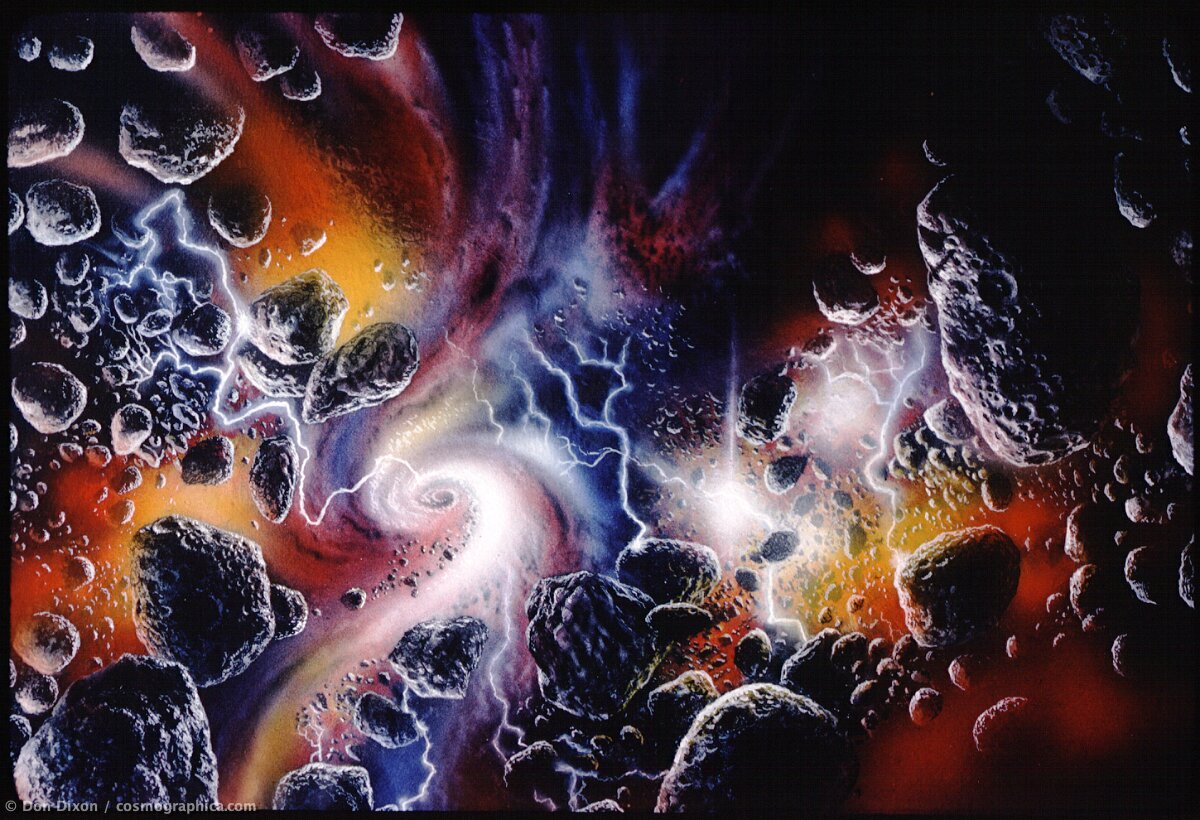
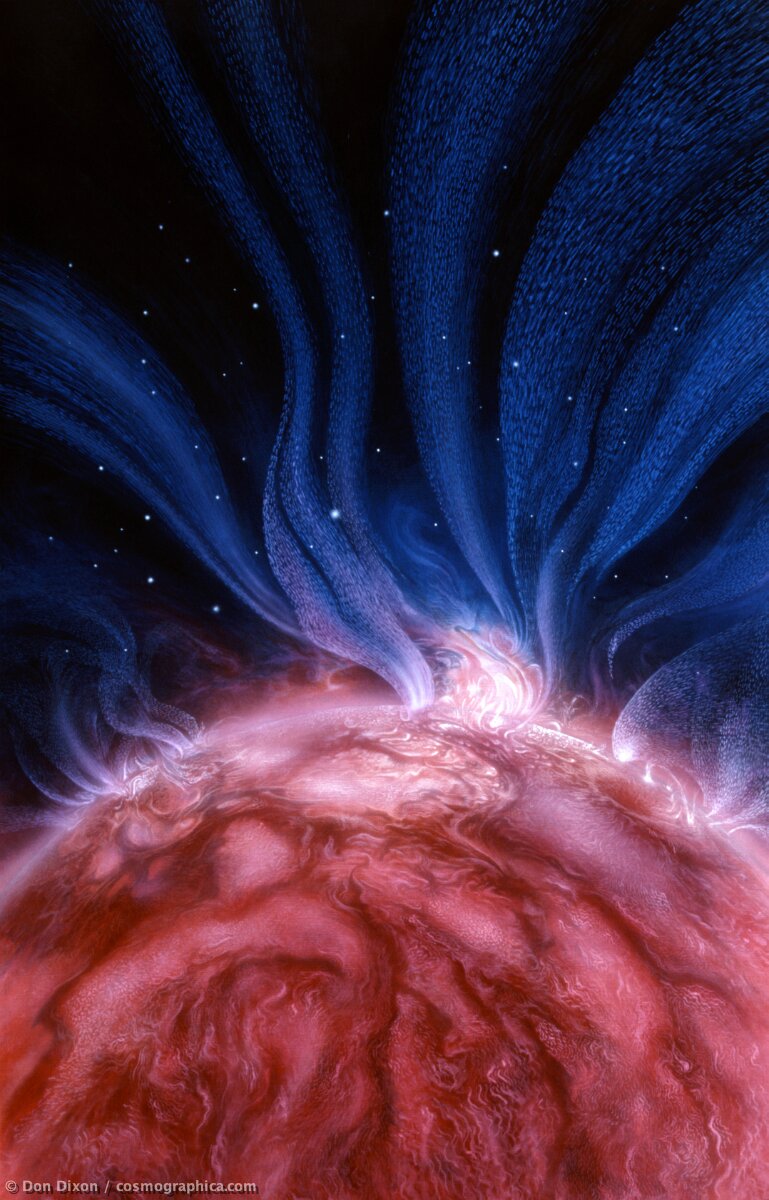
This illustration represents a pulsar, the rapidly rotating neutron star at the center of the Crab Nebula. The scene visualizes the intense magnetic field lines emerging from the stellar remnant, with relativistic particles tracing complex paths along the magnetosphere. A surrounding shell of ionized gas suggests the pulsar wind nebula environment created by the energetic emission of the central object.. Oil on masonite, 1974. artwork © 2007 Don Dixon/cosmographica.com
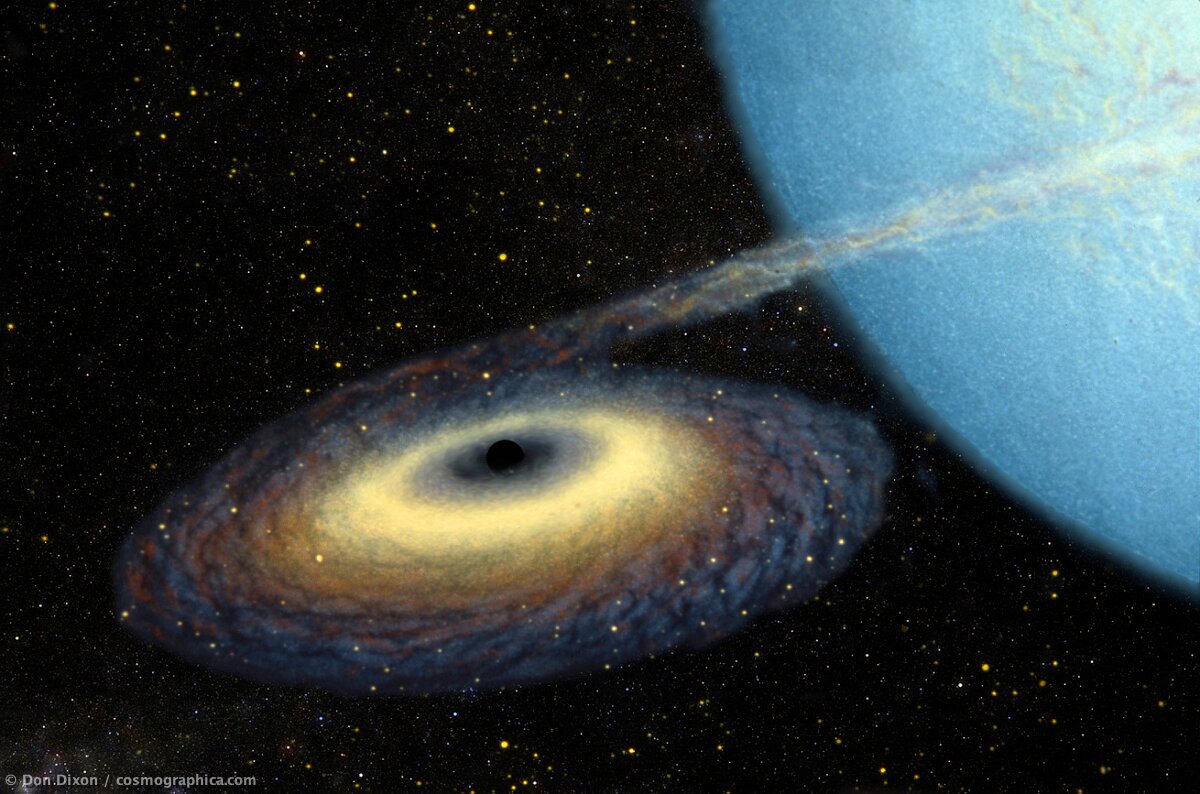
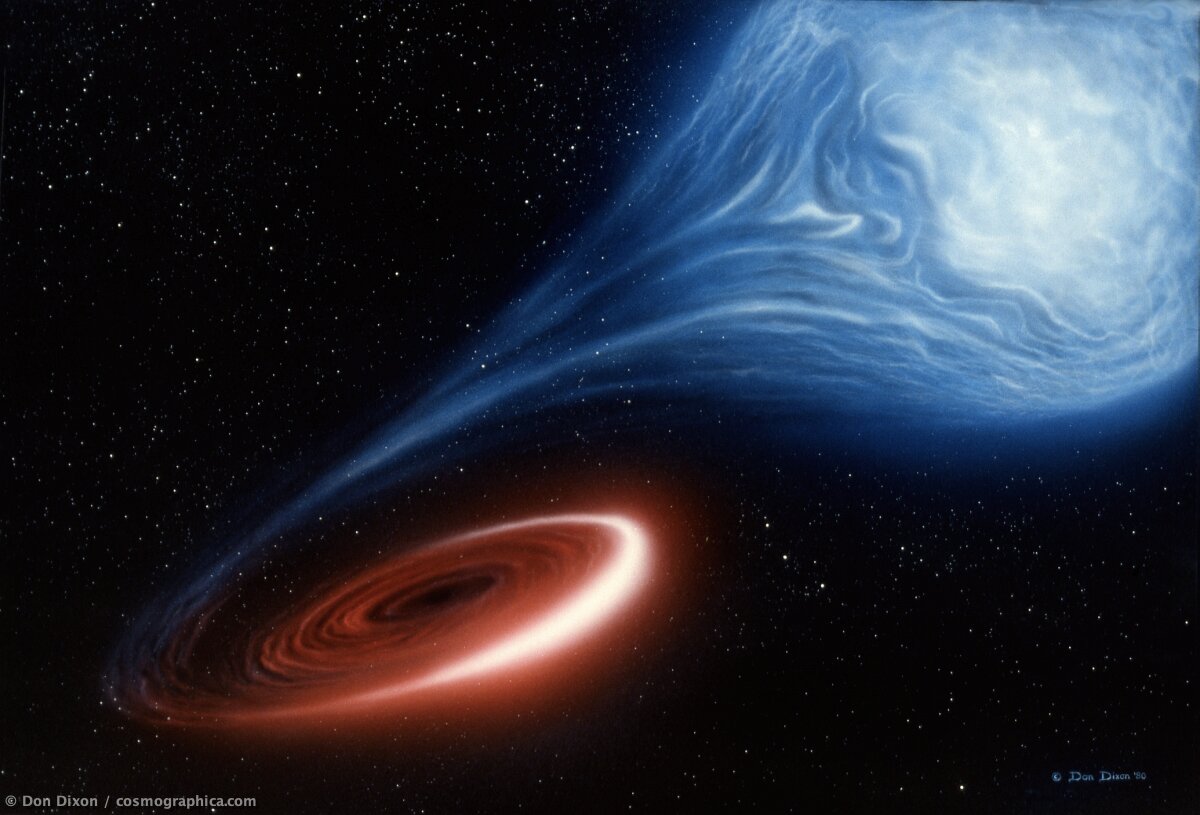
059-Cygnus-X-1 Black Hole
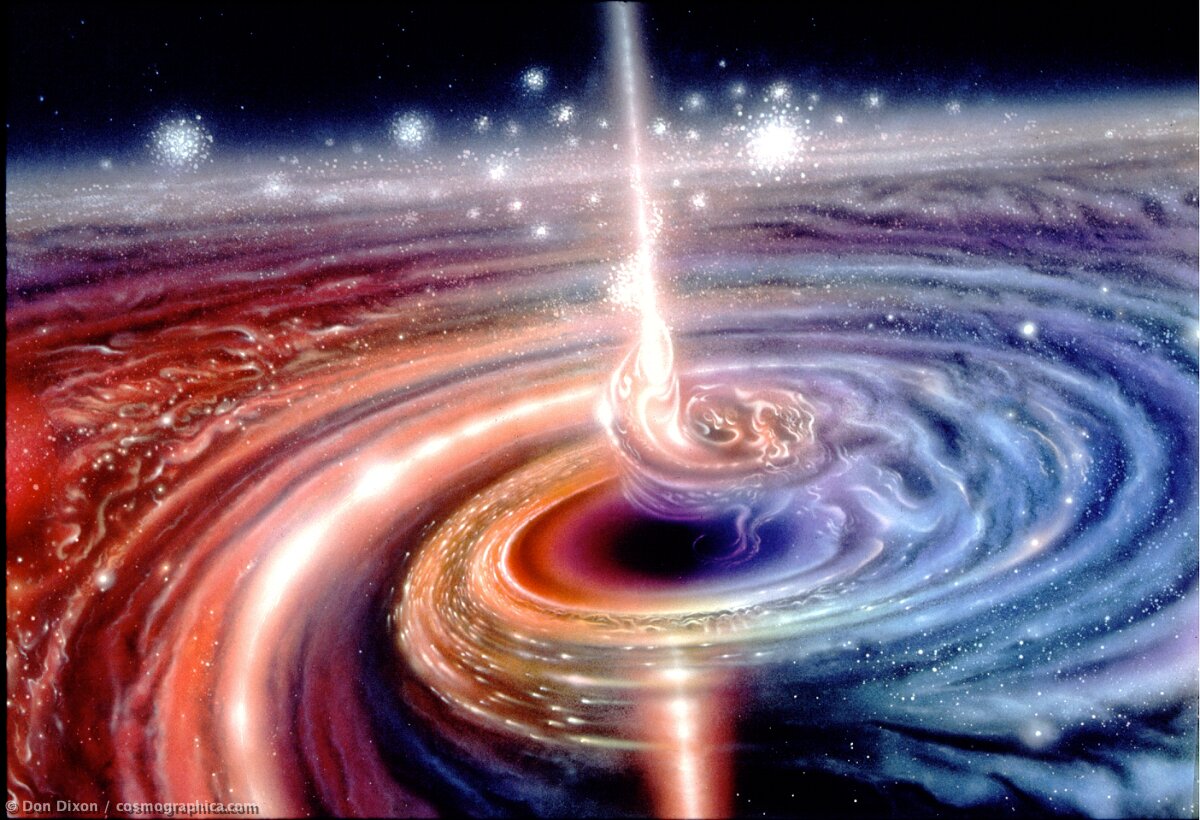
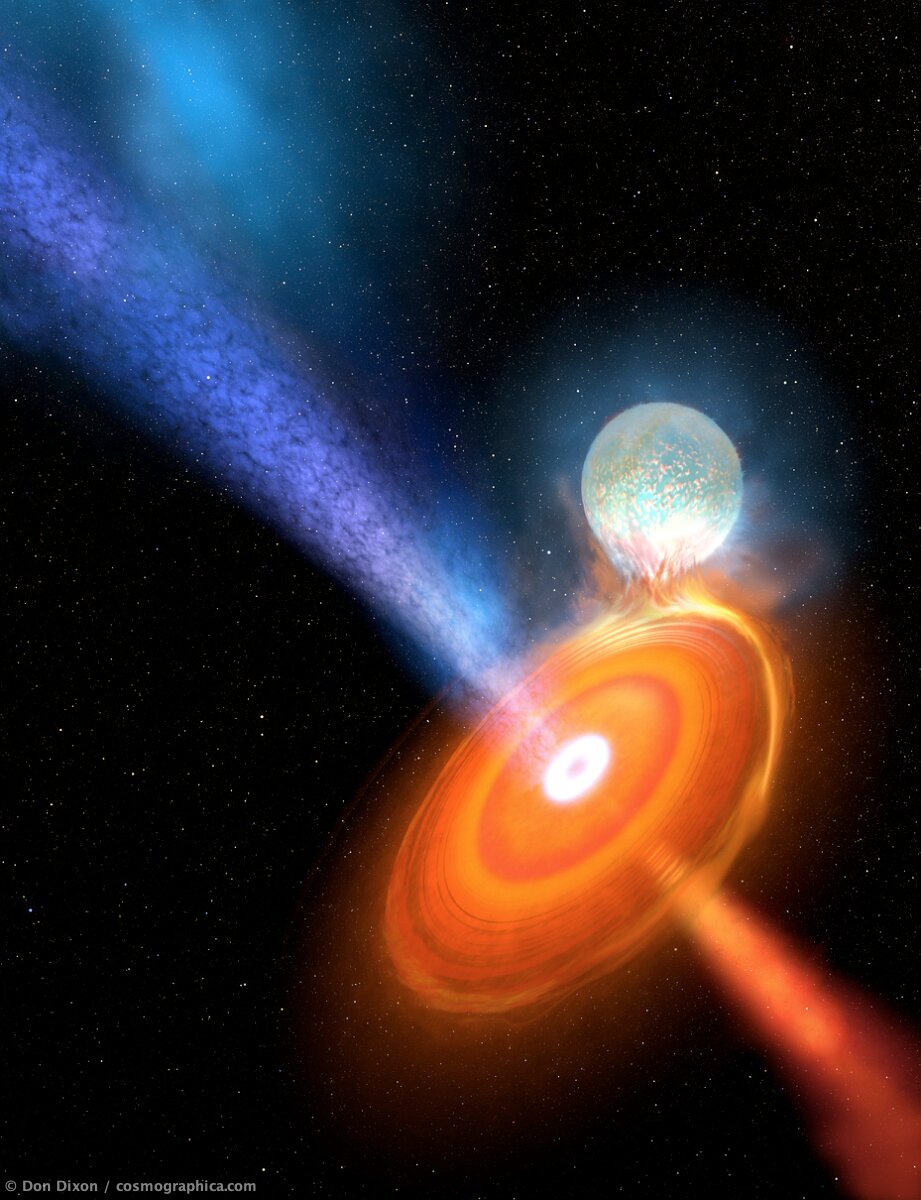
[059] Cygnus X-1 — This astronomical painting illustrates the Cygnus X-1 high-mass X-ray binary system, featuring a blue supergiant star (HDE 226868) undergoing Roche lobe overflow. Stellar material is being pulled toward a black hole, forming a glowing accretion disk that spirals toward the event horizon against a dense star field background.; gouache on illustration board, 1975. © Don Dixon
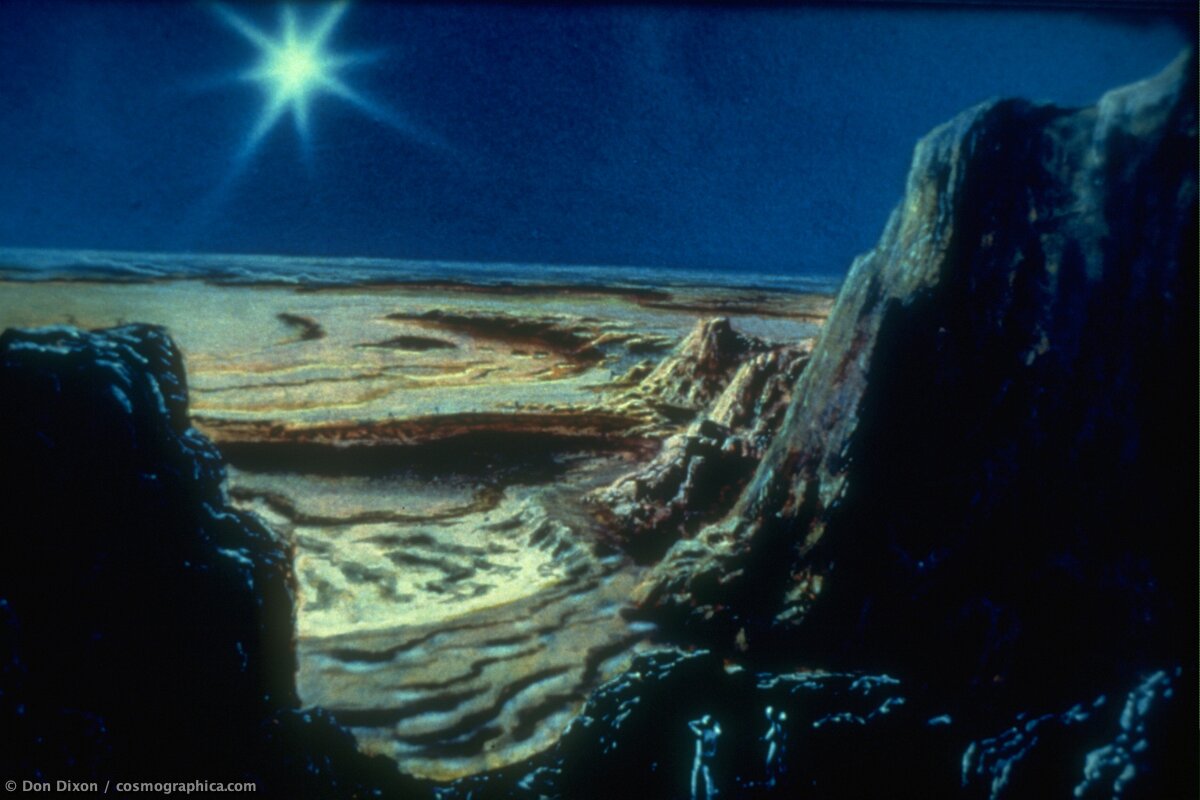
334-Algol-Binary
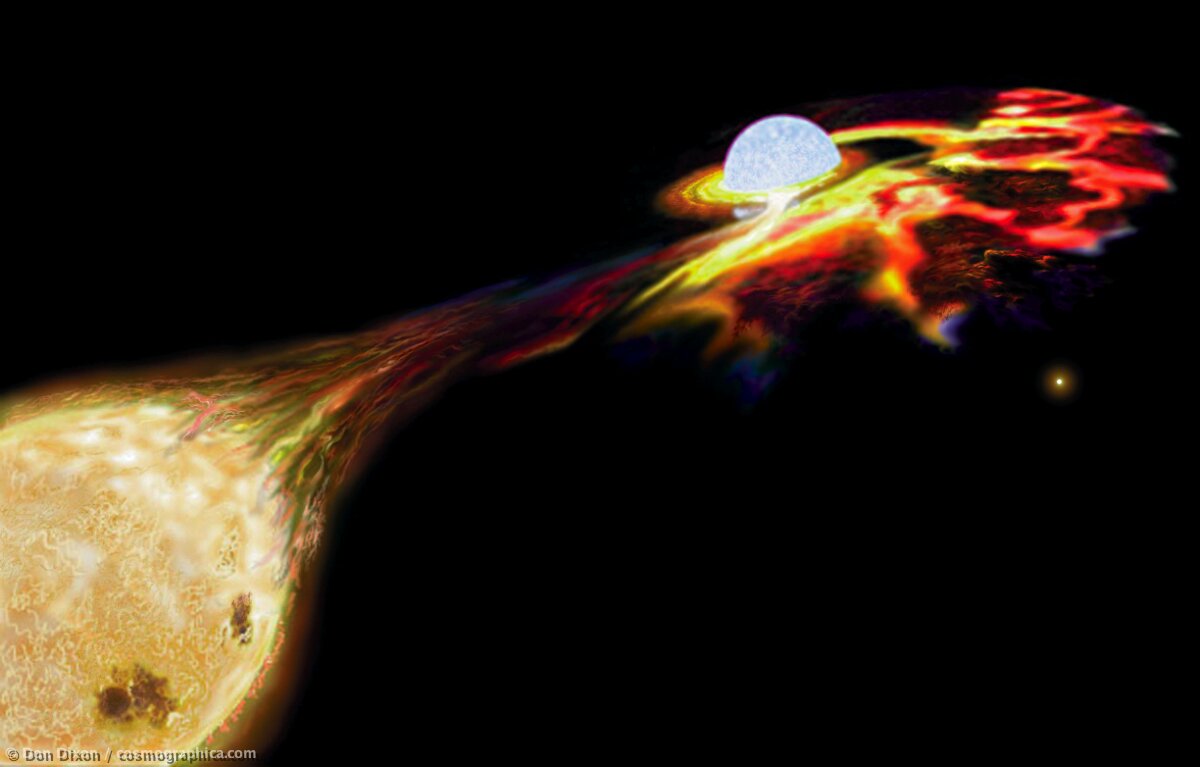
[334] Algol Binary — An illustration by Don Dixon depicting the Algol binary star system, demonstrating the process of Roche lobe overflow and active mass transfer. A cooler, orange-hued subgiant star is shown losing outer layers of gas to a more massive, blue-white main sequence companion through a concentrated stream. The captured material forms an uneven accretion disk around the primary star, while magnetic activity is indicated by darkened starspots on the donor star's surface. This digital illustration was created in 2004 for use in astrophysical journals and educational textbooks to explain the Algol paradox. interior Sky and Telescope - painting by Don Dixon
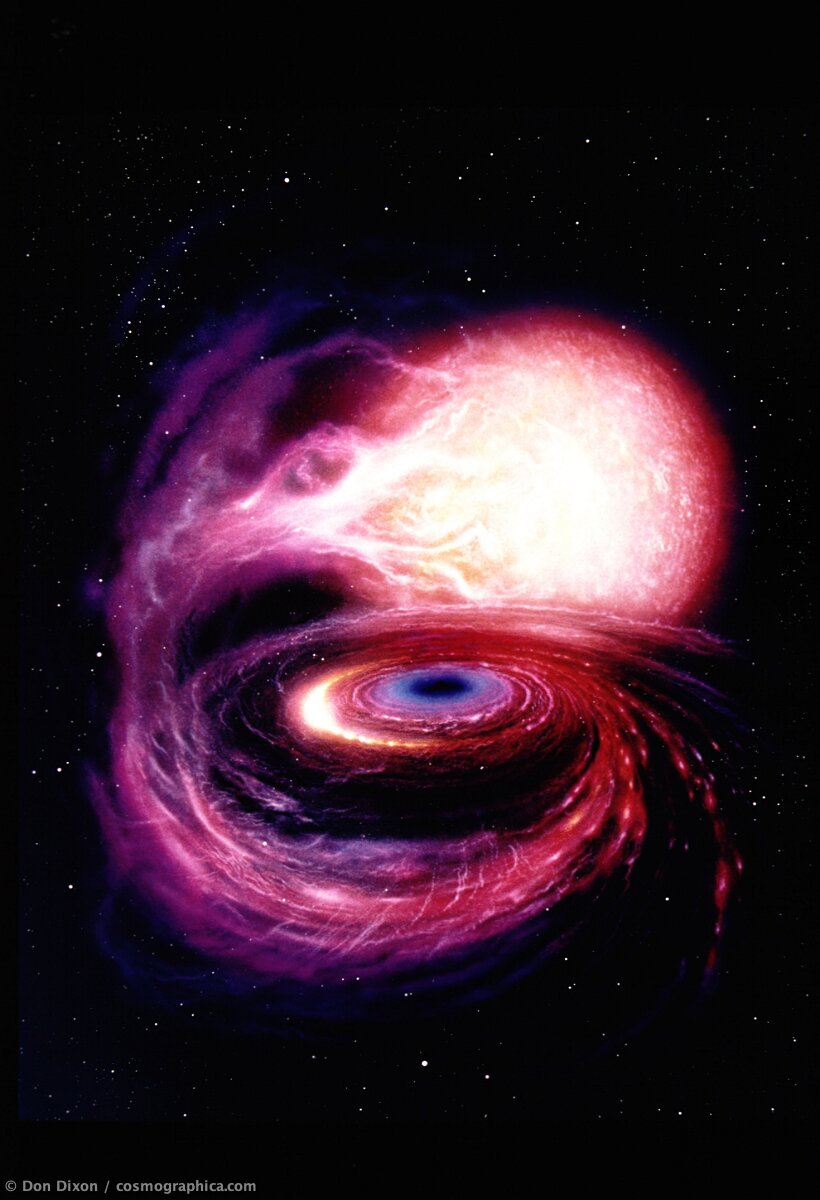
398-Trinary-Black-Hole.jpg
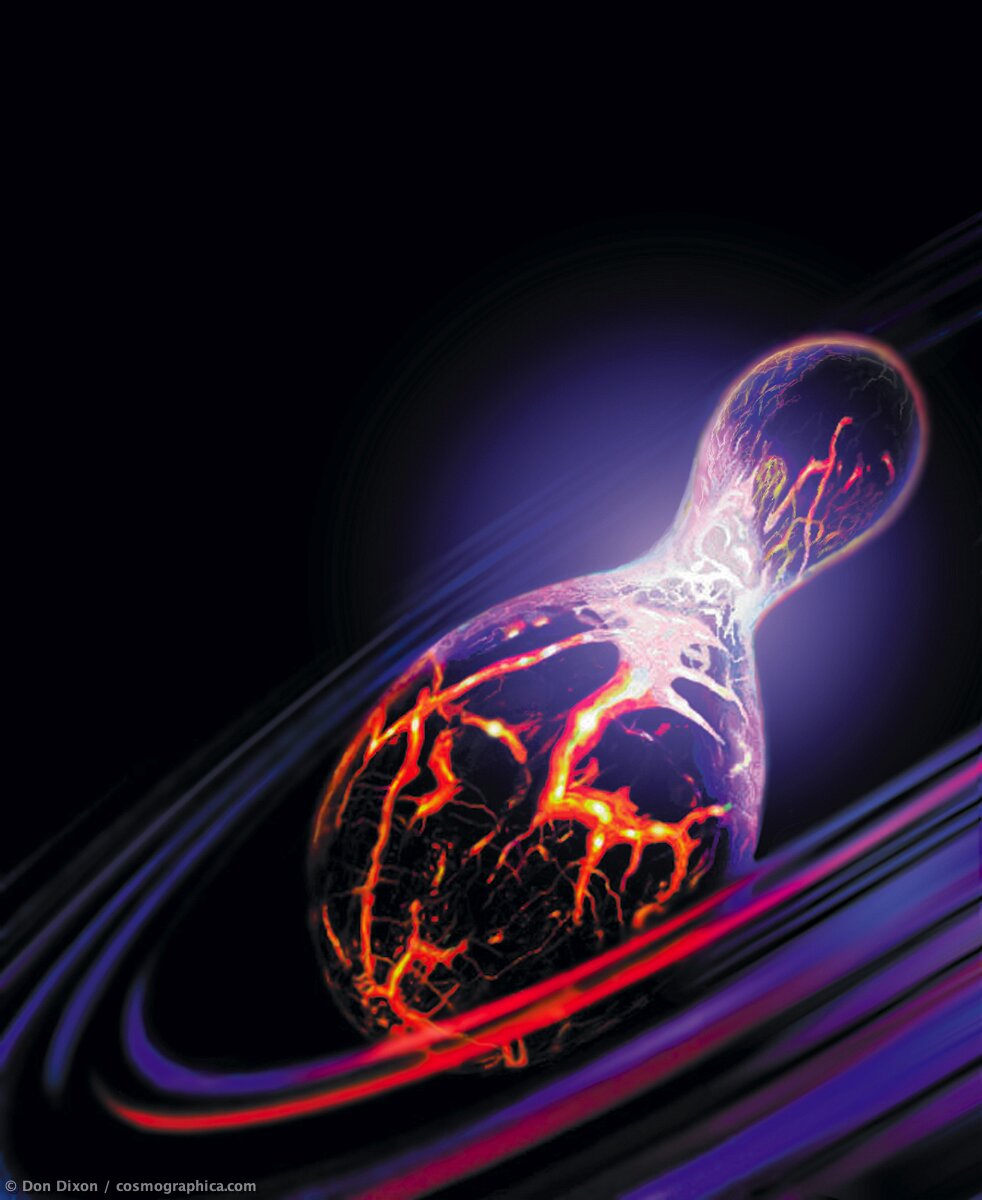
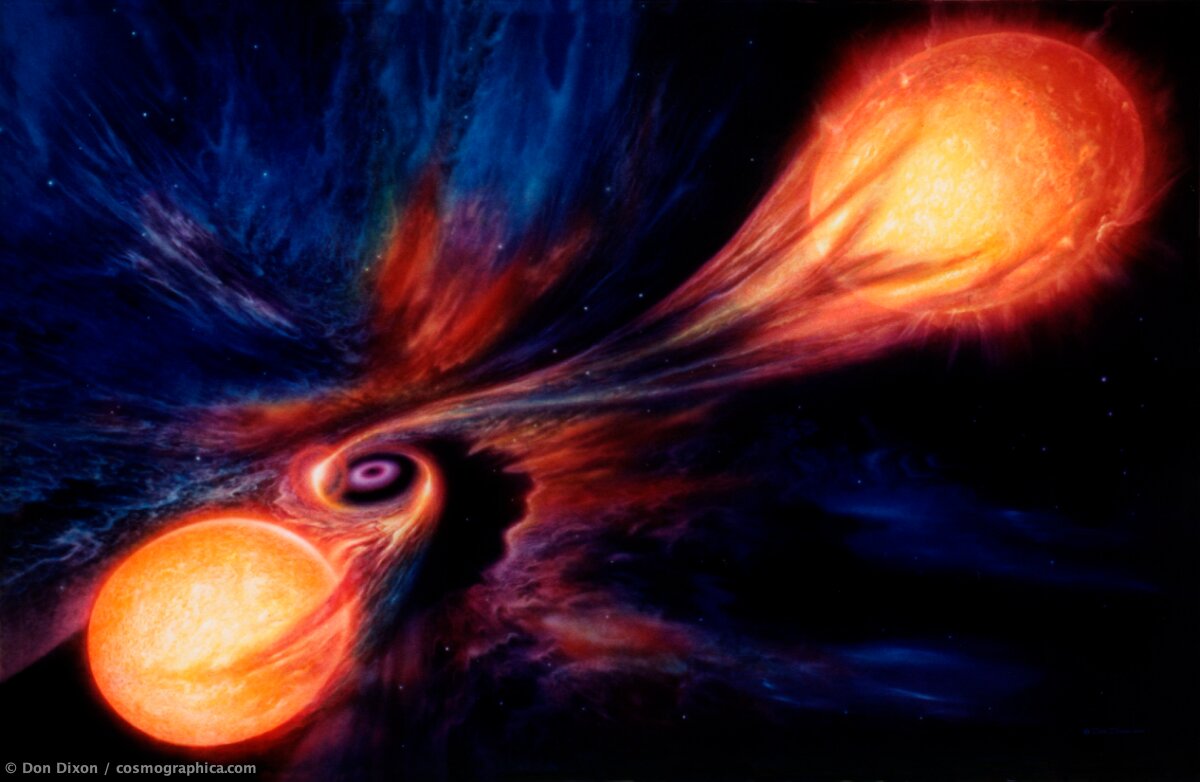
[398] Trinary Black Hole — A black hole rips apart two companion stars in this private commission. The cores of two red giant stars spiral toward destruction. Sputtering explosions of infalling gas are blasted into space as the three objects dance around their ever-shifting center of mass. The painting was created with acrylic and oil glazes on a 4'x6' canvas.
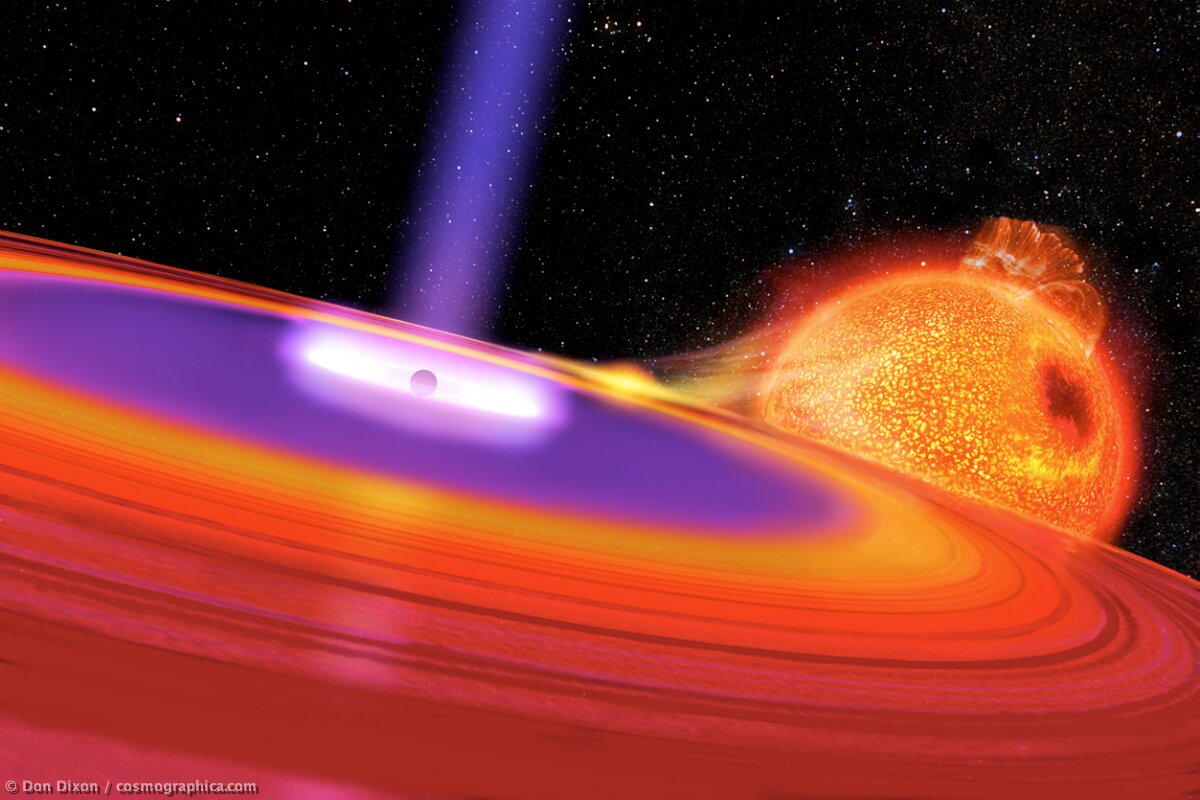
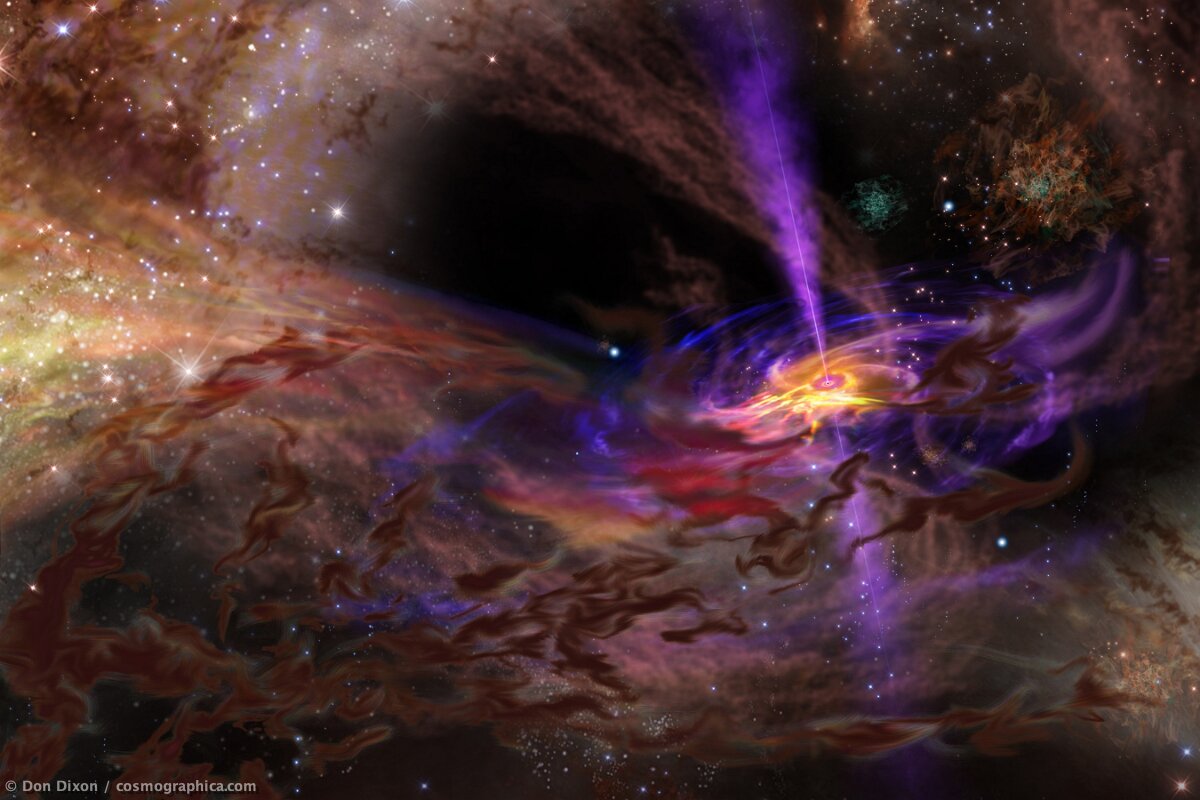
This illustration provides a high-detail perspective of a stellar-mass black hole system. A companion star is shown undergoing significant Roche lobe overflow, with a distinct stream of stellar plasma being pulled into a massive, multi-layered accretion disk. The disk transitions from vibrant orange and red outer regions to a luminous, white-hot interior. A powerful relativistic jet of purple ionized matter is shown being ejected perpendicular to the disk from the vicinity of the event horizon, a hallmark of active high-mass X-ray binaries.. Digital, for Scientific American © 2005 by Don Dixon.
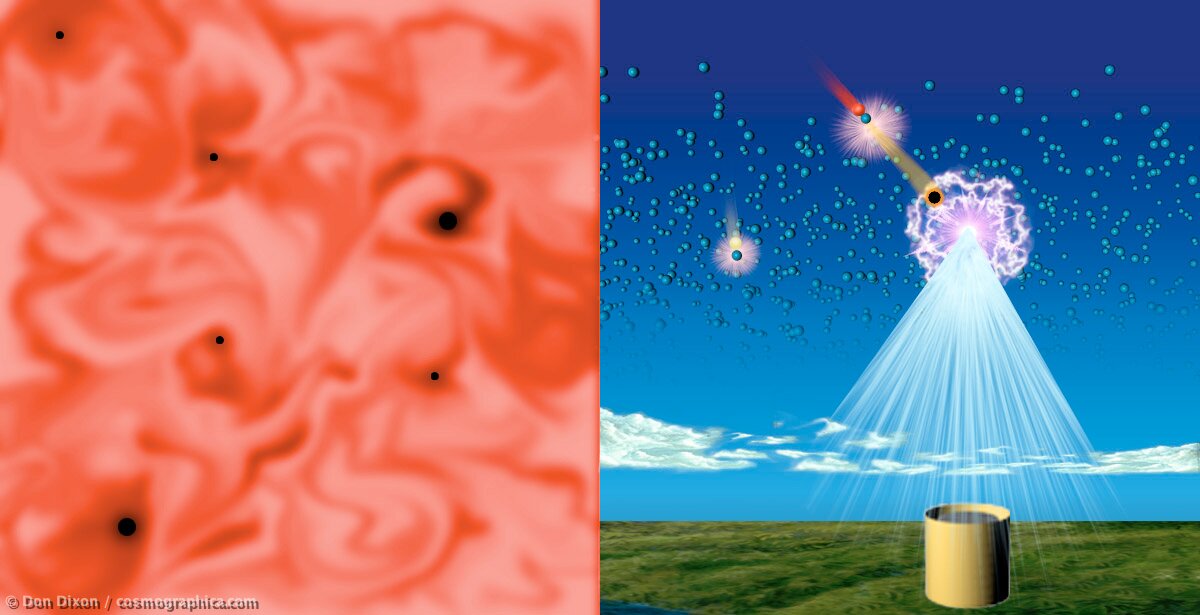
424-Micro-Black-Holes-Forming
[424] Micro Black Holes — An illustration by Don Dixon presented as a diptych, conceptualizing the formation and detection of primordial or microscopic black holes. The left panel visualizes quantum fluctuations in the early high-density universe leading to the collapse of primordial matter into small-scale singularities. The right panel represents a theoretical detection scenario where a micro black hole interacts with Earth's atmosphere, producing a characteristic shower of secondary particles and radiation detectable by ground-based sensors. This digital composite was created in 2008 for scientific publications exploring dark matter candidates and high-energy particle physics. Digital diagram for Scientific American, 2005. © 2005 by Don Dixon.
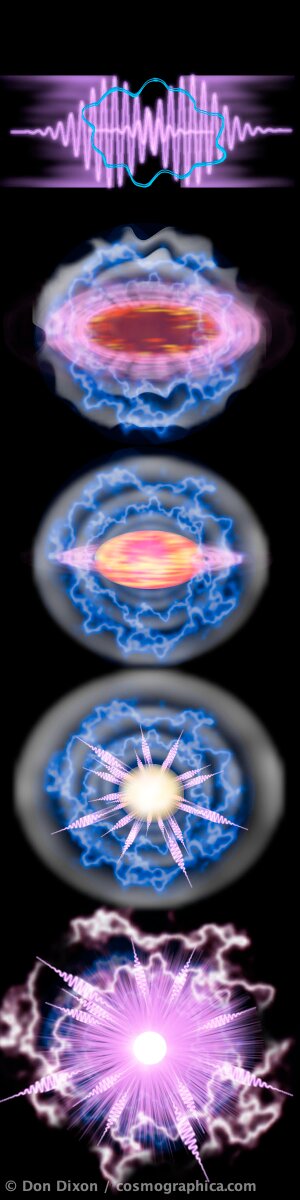
450-black-hole-blowback-02
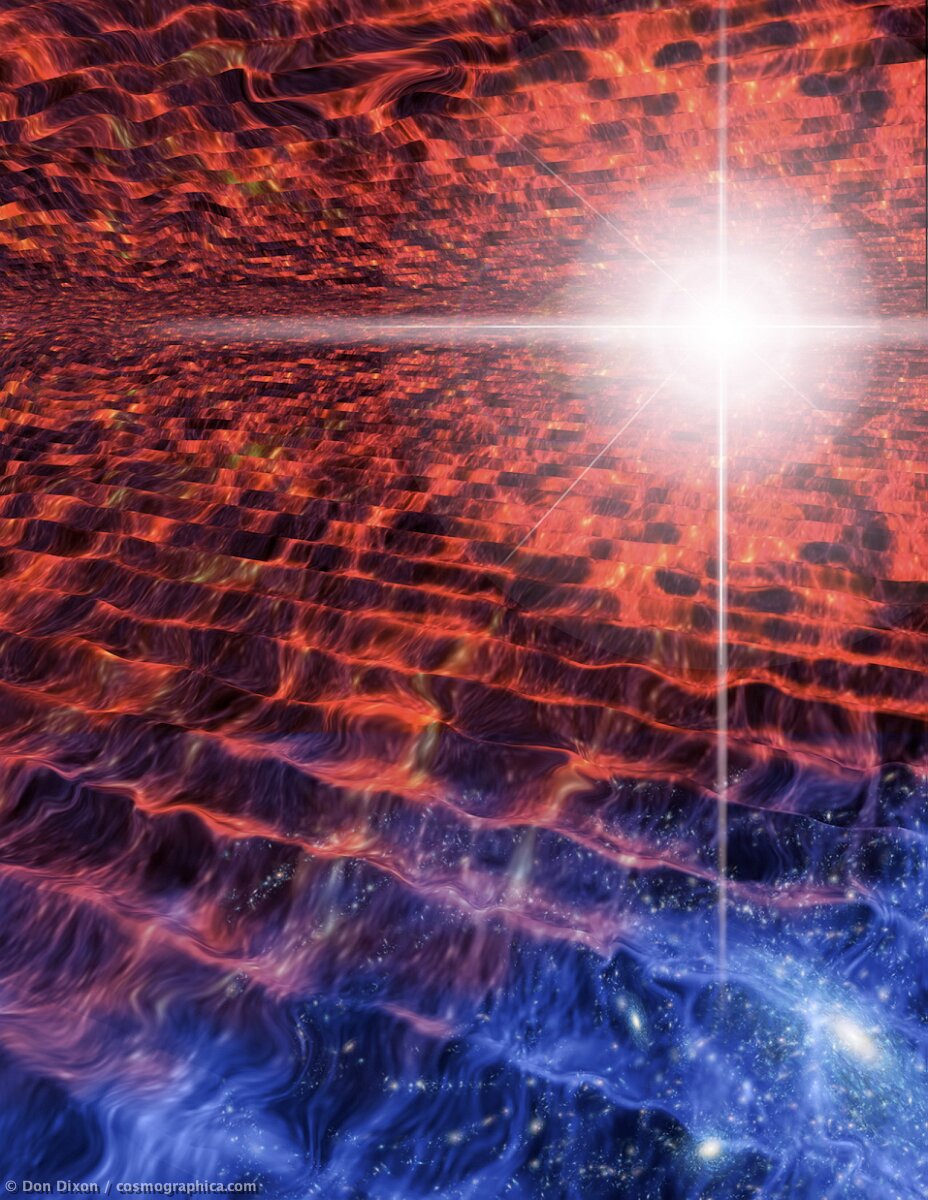
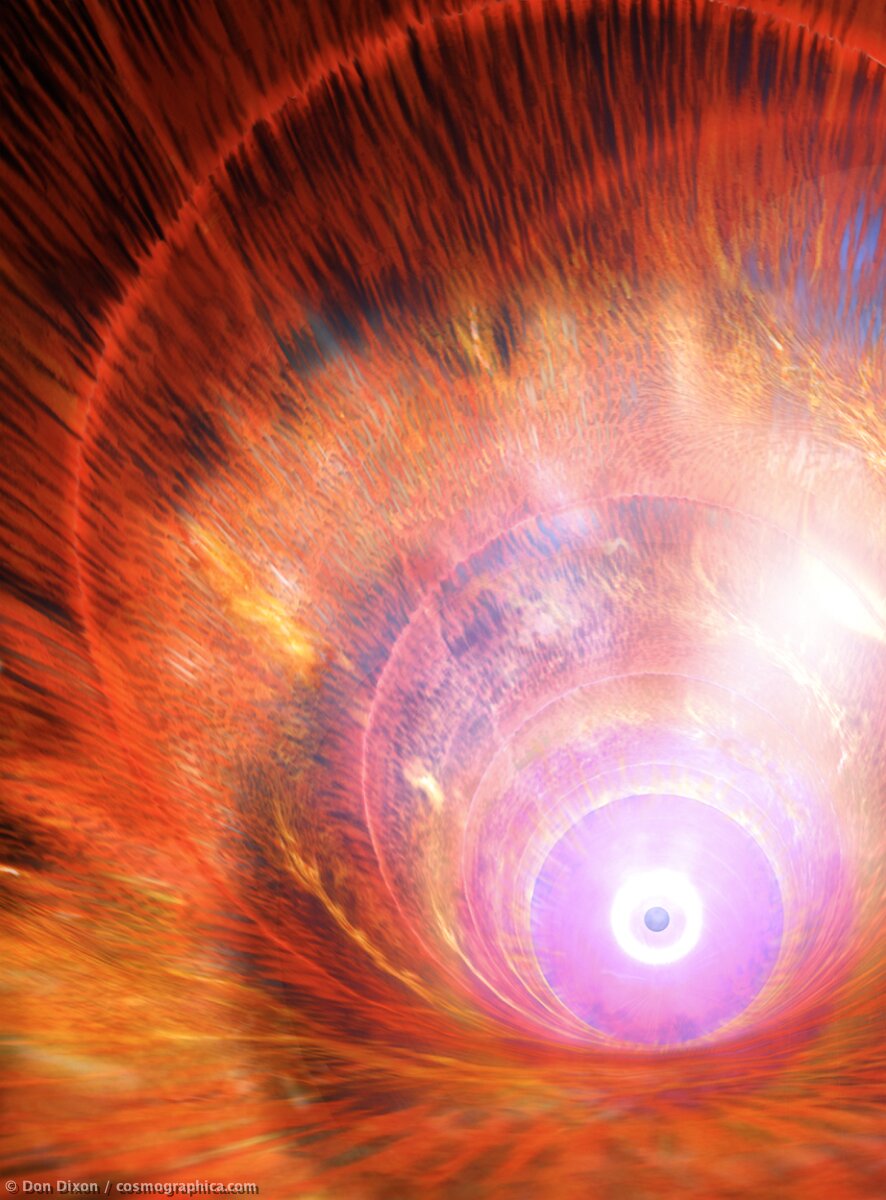
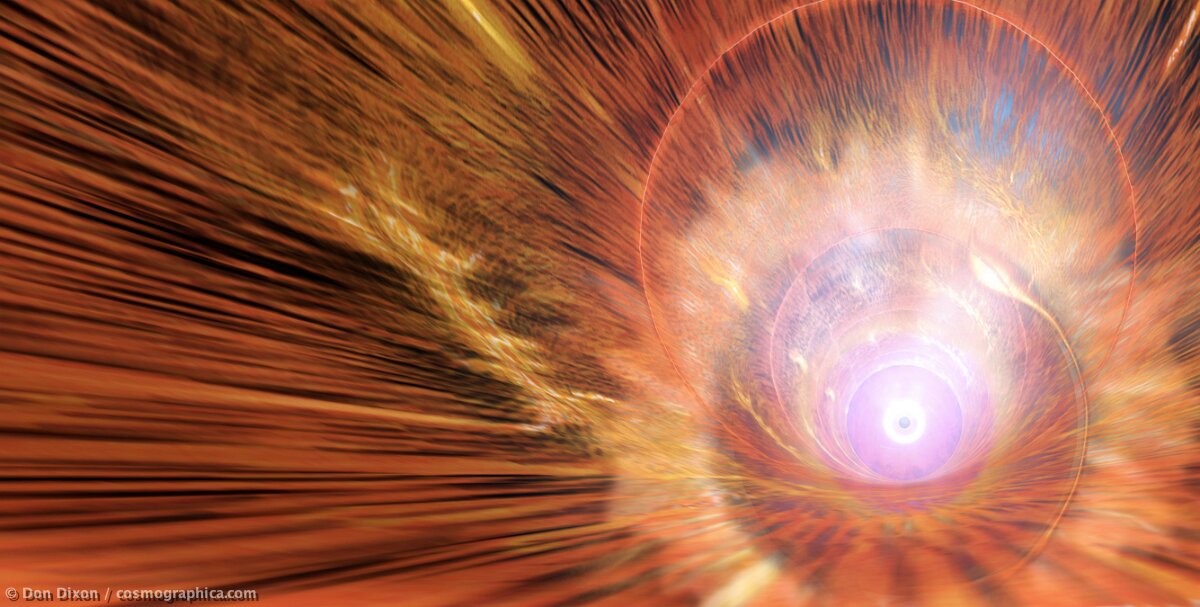
[450] Black Hole Blowback 02 — An illustration by Don Dixon depicting galactic feedback mechanisms driven by a central supermassive black hole. The scene visualizes the "blowback" effect, where intense radiation pressure and thermal energy from an active galactic nucleus clear the surrounding region of gas and dust, forming concentric shock fronts and shells of glowing plasma. This digital illustration was created in 2008 and has been featured in astrophysical media to illustrate the regulation of star formation and the mechanical influence of black hole outflows on host galaxies.We see one of the most energetic processes in nature as we look down the "throat" of a galactic jet. ADigital painting for special "Black Holes" edition of Scientific American. © 2007 Don Dixon/cosmogracosmcosmographica.com
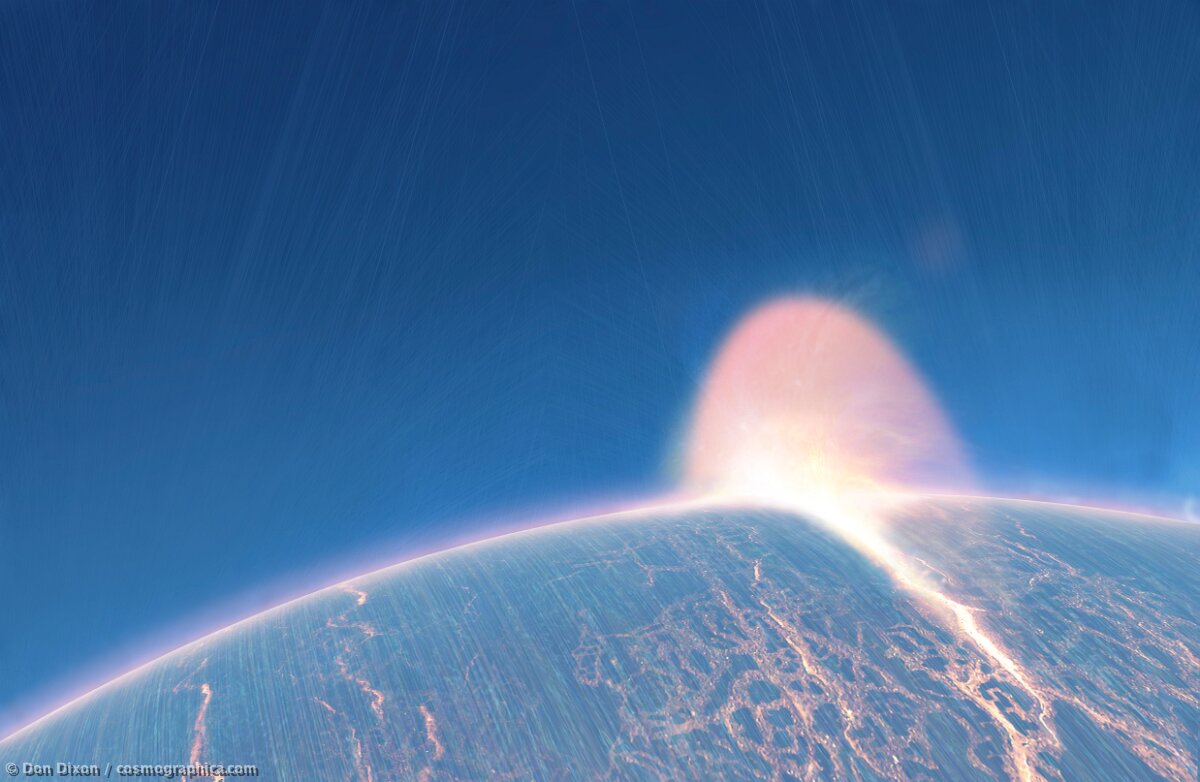
Fast Radio Burst Magnetar
[frb_fin_001] Fast Radio Burst (FRB) — This scene illustrates the "starquake" model of a magnetar, a type of neutron star with an ultra-strong magnetic field. The artwork depicts a rupture in the stellar crust, which triggers a catastrophic reconfiguration of magnetic field lines and the subsequent release of a Fast Radio Burst (FRB). The resulting emission is shown as a high-energy plume of radiation erupting from the fractured surface into the magnetosphere. Illustration by Don Dixon.
[Publication History]: This illustration was prominently featured in the June 2019 issue of Astronomy magazine to accompany the article "Cosmic Firecrackers," which explores the origins of Fast Radio Bursts. It is also documented within the artist's "Exotic Stars" digital archive.
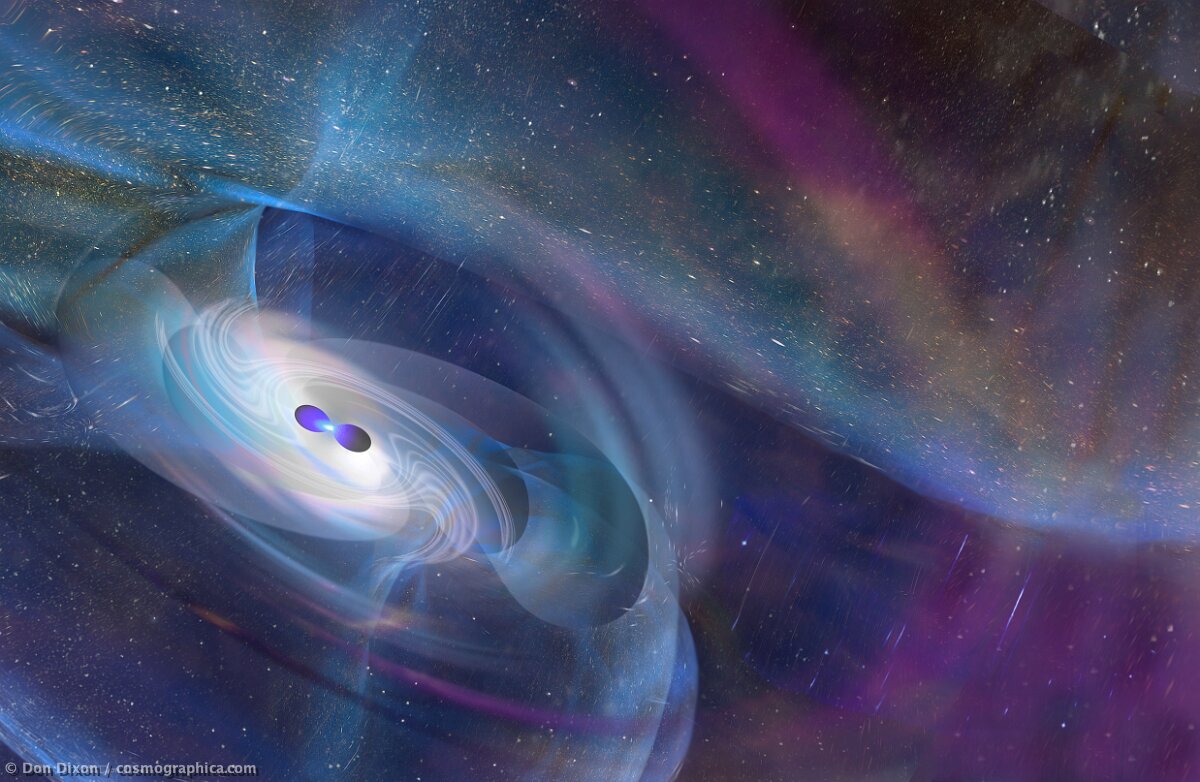
504 Gravity Waves radiate as black holes merge
[504] Binary Black Hole Merger — An illustration by Don Dixon depicting the merger of two stellar-mass black holes and the resulting emission of gravitational waves. The scene visualizes the final stages of a binary inspiral, where the orbital decay of the singularities creates intense ripples in the fabric of spacetime, rendered as concentric, glowing blue and white distortions against a multi-colored nebular background. This digital has been utilized to represent the astrophysical events detected by laser interferometry. Interior painting for November, 2017 Astronomy Magazine shows the space-time distortions produced as two black holes merge. © Don Dixon / cosmographica.com