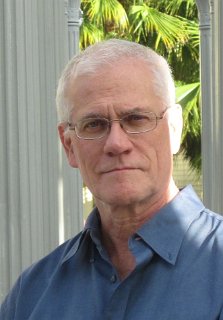
A Brief Autobiography
Don Dixon: Space Artist, Animator and Scientific Illustrator
(see also the interviews at "Planetary Radio" , "SFsite" , the Los Angeles Times and a partial Credit List)

The following was written to answer some frequently asked questions about astronomical art, my techniques, background, and sources of inspiration.

I was born in 1951, six years before Sputnik, in Easton, Pennsylvania, next to the Delaware River where it borders New Jersey. My mother, then recently divorced, took me to Glendale, California when I was three. We moved to New Jersey when she married my stepfather a year later. It was his parents who had the farm that was the delight of my childhood summers. My stepfather was, at the time, a licensed pilot and state bee inspector. He sometimes took me along on bee inspecting expeditions and helped me develop a fondness for airplanes and rural landscapes. Eventually he pursued a career as a draftsman, and sometimes let me use his drawing tools. We moved around a lot when I was a kid. There were a succession of apartments and houses, few of which we stayed at for more than 6 months. I went to kindergarten in Sault Ste. Marie, Ontario, and remember seeing the aurora borealis one night. We lived in Michigan, New York, Ohio and eventually moved back to California when I was around 10. California has been my home since then.

My visual memory seems to go back to infancy, suggesting that my brain might have been particularly densely wired in this respect. I recall looking down on the bannister at my maternal grandfather's house -- a perspective that could only have been achieved with help from an adult, since I was just a couple of feet tall at the time. Many scenes are framed by the bars of a crib or playpen. One scene, particularly vivid, is of a patch of sunlight shining on a hardwood floor on which I was sitting. I remember being delighted by the dust motes swarming in the air before me, and by my ability to create shadows in the beam. Light of any kind was fascinating. Summer evenings at my grandmother's farm in New Jersey were a particular treat, because of the lightning bugs. To this day, when I have occasion to visit the east coast in July, I make it a point to find a place where I can enjoy watching the fireflies at dusk.

The first drawing I can recall creating was of a meteor, observed from the back seat of my grandfather's Studebaker when I was about 4 years old. It was rendered in crayons and was apparently of sufficient quality to permit my grandfather to identify the object that had so startled me. At around this same time I postulated my first astronomical theory, to wit: the reason the moon always seemed to follow us home was because the earth was spinning under the wheels of our car, thus making us motionless with respect to the moon. This idea is of course not correct, but far less plausible theories have been embraced by millions.

I was a big "Superman" fan at this time. The idea of a "strange visitor from another planet" was intriguing. Sometimes now, on clear days, I can pick out the obelisk of the Los Angeles City Hall building five miles away from the Griffith Observatory on Mt. Hollywood where I work. Afficionados of the George Reeves TV series would recognize it as the Daily Planet Building where Superman/Clark Kent had his day job. On such days, my inner child gives the cranky middle-aged man a playful nudge; who would have thought that I'd someday enjoy such a panoramic view of Metropolis?

My fascination with things astronomical grew during this period. I remember standing in the lobby of a movie theater when I was around 6, absolutely amazed by the backlit stills featuring scenes from "Forbidden Planet", which Arthur C. Clarke once rightly described as "one of the half-dozen or so science fiction movies that one can point to without embarrassment." I still have a copy of the garish poster featuring Anne Frances fetchingly draped across the arms of Robbie the Robot, and the image of the flying saucer settling onto the rugged desert landscape of Altair IV is embossed on my visual cortex.

Around this time I also was given a copy of "The Golden Book of Astronomy". The illustrations by John Polgreen are still marvelous examples of science visualization; they are dramatic, beautiful, engaging, and accurate (within the context of 1958). My copy shows indentations in the pages where I laboriously traced some of the images so I could copy them in crayons or watercolors. I didn't know it then, but many of his "artist's conceptions" of alien worlds were in turn inspired by an even greater artist: Chesley Bonestell, the Grand Master of astronomical art.

It's odd, but I don't recall the first time I saw a Bonestell painting, although it must have been an epiphany of sorts. I first became aware of the artist's name (which might loosely be translated as "Good Star" in Italian) in a juvenile novel by Robert A. Heinlein -- "Have Space Suit: Will Travel" -- which I read when I was 10. In it, the main character, who finds himself kidnapped to Pluto, speaks of an illustration of that world in National Geographic that had been "Bonestelled to look like a photograph." I thought it was a technical term at the time, but eventually stumbled across a copy of the "Conquest of Space", by Bonestell and Willey Ley.

Chesley Bonestell was an architect-turned-painter who combined a fascination with astronomy with a profound understanding of perspective to create some of the most dramatic and beautiful paintings of the last century. His classic "Saturn as seen from Titan" inspired many future rocket scientists and astronomers during the decades preceding the space age, and every modern astronomical artist is in his debt. Other illustrators had ventured beyond the atmosphere before him. Some, such as Lucien Rudaux, were even trained astronomers who applied their knowledge to produce accurate renderings of celestial objects. But Bonestell's landscapes have a drama and weird alien beauty that has rarely been matched and never surpassed.

When I first discovered this work, I had no intention of ever doing it professionally; all I knew is that I wanted those pictures on my wall. The only way I could think of achieving that goal was to copy them, so painstakingly, using every medium from pastels to oil paints, I tried to imitate Bonestell. I still have a few of these early efforts and am glad that I never showed them to the master, because he would certainly have encouraged me to pursue another trade. There is no trace of native talent in those pictures, but they do show a dogged determination and obsessive attention to detail, both of which can sometimes compensate for a dearth of talent.

An aside on "talent": I suppose it exists. People like Mozart or the mathematician Gauss (who amused himself with geometric progressions as a baby) can be properly described as being "gifted." They have something in abundance that the rest of us have in moderation. But I think, generally, on the scale of normal human achievement, talent consists mostly of being passionately interested in something. I think talent is a matter of focusing one's consciousness, often to the exclusion of other aspects of life. Most people find their way by the diffuse light of a 100 watt bulb; they see everything with reasonable clarity but perhaps not too intensely. Talented people, on the other hand, may focus their 100 watts into a pinpoint laser beam; they perceive the object on which their their beam falls very well, but often stumble over the ordinary furniture of life.

During my teens, painting was one of many hobbies. I also built a number of telescopes, grinding, polishing, and optically figuring the objective mirrors myself. I decided at some point to become an astronomer and read everything I could find on the subject. Eventually I wound up as a physics major at the University of California at Berkeley and had a chance to see the reality of the profession first hand; it appeared to be mostly a matter of teaching and writing grant proposals. The aspect of astronomy that I liked -- observing the sky -- was a fairly rare activity. Modern telescopes are so expensive to run that astronomers must schedule observations sometimes years in advance, hoping that the weather will cooperate. While I still had great admiration for the profession, it didn't seem like something that I really wanted to do.

I decided to see if I could sell the astronomical art I had been creating as a hobby. I bought a small ad in "Sky and Telescope", the premier popular astronomy magazine in the U.S., advertising color slides of my work. Rather to my surprise, people actually ordered them. From 1972-1974 I painted feverishly, trying to create as many new pieces as possible to build repeat business. Schools and planetaria were very loyal customers, as were several hundred space art afficionados. The Spacescapes business supported me while I was learning to paint.

I also began submitting slides to various magazines. My first cover, a painting of Jupiter over a desert-like Io, appeared on the Sunday supplement magazine Family Weekly in November of 1974. A cover for The Magazine of Fantasy and Science Fiction followed soon after.

Around this time I received a phone call from George Van Valkenberg, a producer of documentary films. He was making a short film for NASA about the Pioneer mission to Jupiter and thought I might be able to help with the animations. He introduced me to Don Piccolo, an animator who had worked on previous Van Valkenberg projects. Don took me under his wing and introduced me to the art of animation. I regard him as my primary mentor. He taught me fundamental techniques of illustration, including how to use an airbrush.

This latter tool bears some discussion. Like many illustrators, I've had a love-hate relationship with the airbrush. The airbrush is essentially a pen-sized paint sprayer. There are many variations of the tool, but all of them have a small color cup that holds a thin mix of acrylic paint, a trigger to control the paint and airflow, and a spray nozzle. Compressed air atomizes the paint. Properly tuned and cleaned, a modern airbrush can be used to spray pencil-thin lines as well as smooth sky washes. It is a wonderful tool for quickly creating the sort of gradients that help give a rendering a photographic effect. Unfortunately, it is also a high-maintenance tool. Every minor color change is a matter of cleaning and refilling the color cup. For optimal performance, the atomizing needle has to be polished to a brilliant sheen, so that clumps of pigment will not build up on it. A ten-minute phone call can allow paint to dry in the nozzle, so that 20 minutes are required to become operational again. Additionally, the first airbrush I used, a Thayer and Chandler, required a beeswax seal behind the nozzle to prevent air bubbling into the color cup. Alcohol, used to clean acrylics from the color cup, dissolved this seal, so it had to be constantly replaced. All things considered, the airbrush, while greatly expanding the range of techniques in the artist's arsenal, can be a royal pain. Still...it was a quick and relatively easy way to achieve certain results that are difficult to obtain with other methods.

When Don Piccolo discovered that I was creating my images by painting in oils on 24x36" canvas panels, he showed me his Acme animation frame. This is a backlit, frosted plexiglass easel that can be rotated. It contains two sliding horizontal bars, labeled North and South, containing pegs on which can be placed a hole-punched acetate "cell". This is the stage on which the traditional animator creates his world. Layered cells can be panned left and right to test motions, so that the animator can see how a character will play against a background landscape, for example. Piccolo's point in showing me this was to explain that I had to find a different way to paint if I was to become an animator: a typical animation cell is about the size of a letter and is, of course, made of smooth, clear plastic -- a surface impossible to paint on with oils. Clearly, I had to learn new techniques. Don lent me some Cel Vinyl animator's paints and suggested that I buy an airbrush.

Off I went to the late and much-lamented Standard Brands paint store to buy my first airbrush. I needed an air supply so I bought a can of Propel -- spray paint without the paint -- and an adapter to hook the airbrush to it. Nobody mentioned that I needed a device to regulate the pressure as well, so I quickly filled the studio with clouds of blue mist sprayed at 200 psi directly from the can. I thought it odd that I had to stand two feet from the painting in order to prevent the paint from splattering. As the Propel gradually depleted, the pressure dropped and the airbrushing became more manageable. I decided to try an air supply with lower pressure: the inner tube of a car tire. My neighbors must have been puzzled by the sight of me rolling an inner tube back from the corner gas station at all hours of the day and night. Eventually I bought a tank of carbon dioxide with a regulator. This provided a dry source of compressed gas.

Another consequence of learning to paint on a cell was that I had to paint "tight". I would sometimes spend an hour at the art supply store selecting a brush that would hold a small enough point to permit the painting of very fine detail. I have always been very nearsighted, so working close to the painting was no problem in my 20's and 30's, but after age 40 I needed a magnifier to paint on this scale.

Over the course of working on several projects with Don Piccolo during the mid to late '70's I learned most of the techniques of commercial illustration as well as animation. I also learned how to meet deadlines via the infamous "all nighter"; there was one project that required us to stay awake for several days, with occasional naps on the floor. I learned how to cut friskets -- the masks required for airbrushing hard-edged shapes. I learned how to mix paint to quite precisely match any color. I learned the basics of creating special effects. This was a priceless education and I will be forever in Don's debt for it.

During the '80's I branched out into the science fiction field, doing concept design for Roger Corman's "Battle Beyond the Stars" (An homage to The Seven Samurai most notable for having been written by John Sayles and scored by James Horner. James Cameron, who would direct The Terminator and Titanic, worked in the miniatures shop and later became art director for the film). In 1983 my friend and colleague Rick Sternbach (who would eventually become Senior Illustrator for several "Star Trek" projects) put me in touch with Don Munson, then Art Director of Ballantine Books, who kept me busy for several years painting book covers. Other publishers also gave me cover assignments, but this market petered out in the early '90's. Faced with a mortgage and new baby I took my first honest job since college, as Art Director of the Griffith Observatory in Los Angeles, designing graphics for planetarium shows and publications. At the time of writing (December, 2004) the observatory is nearing the end of a 4-year renovation and my colleagues and I are producing animation for the full-dome laser video system that will be installed.

Perhaps the most dramatic professional evolution I've experienced has been the transition from traditional to digital production methods. In 1987 the sculptor and artist Joel Hagen demonstrated the program "Paint" on a Commodore Amiga computer for a group of astronomical artists. The program was limited to a palette of 16 colors, but by choosing them carefully a skilled artist could create quite dramatic results. I recall being impressed by the idea of "painting with light" and being able to easily modify a composition. So many times a commercial client had requested changes to an illustration that may have improved its utility as packaging art but diminished it in other ways. Sometimes client-ordered changes utterly ruined a painting, so that I hated every square inch of it and refused to sign it. Such soul-killing projects had taken such a toll that I came to approach every job with a certain dread, quite unlike the excitement that I felt when young. Digital art, however, allows an illustrator to quite easily modify a picture to suit the client without destroying the original file. Since embracing this technology, around 1996, my contentment and output have both increased.

I now create most of my commercial artwork using Adobe Photoshop on an Apple Powerbook G3 laptop, using a Wacom stylus instead of a paintbrush. The workflow on a typical assignment, such as for Ed Bell, Art Director at "Scientific American" (whose admirable motto is "First get it right, then make it beautiful.") might proceed along the following lines: Initially, a Microsoft Word document, containing a first draft of the article that I'm to illustrate, will be emailed, along with some general specifications for the size and subject matter of the illustrations. Using Photoshop, I will create some fairly "tight" preliminary sketches. This is a hybrid process involving traditional methods as well. Often I will create a pencil drawing that is then scanned into Photoshop for coloring. Sometimes I will do a small acrylic painting to scan and detail. Then I simply email the sketches as jpeg files to the art director and editor. When there are multiple authors I post the sketches at a web site so that all participants have easy access. After several iterations, eventually all parties agree and I email final detailed illustrations to the client. Quite often, the only physical media exchanged are my invoice and the client's check; with foreign clients, even these are usually handled electronically. It's a wonderfully efficient way to work.

Being able to create "commercial" illustration on a laptop has also enabled me to return to my favorite medium: oil paints. Oils have a richness of color unmatched by acrylics, especially when layered as a glaze over white canvas. With patience, and plenty of drying time, subtle airbrush-like glows and gradients can be created with oils. I find that the canvases are gradually growing bigger, probably as much to accommodate my failing vision as to satisfy a sense that I've felt for a long time that astronomical paintings should be BIG! Too often over the years I've observed the mingled astonishment and disappointment of space art afficionados when they see an original painting firsthand; they are amazed by the detail but surprised at how small the boards are. This is a legacy of my animation years. Now that even animation can be created on a laptop, I now have the freedom to return to traditional methods. I'm experimenting with a looser, more expressionistic style of painting and hope to present some examples on this site in the near future.

Since 2004, my life has been dominated by the task of serving as creative director for "Centered in the Universe", the opening show of the renovated Griffith Observatory, set to premiere in fall of 2006. This exploration of our evolving understanding of the universe combines traditional planetarium technology with full-dome immersive video and live theater.

Don Dixon


(please see also a list of publication credits )

CONTACT INFORMATION